

The Frustration of “Perfect” Sleep Hygiene
You wake up, and your body is already heavy. Your chest feels tight, your muscles are stiff, and your head is thumping with a dull, familiar tension. The day has not even started, yet your physical energy is completely depleted. It feels as though you spent the entire night running a marathon, leaving you physically braced before your feet even touch the floor. This leaden morning fatigue is one of the most frustrating realities of living with chronic anxiety.
I know that exact scenario because I lived inside it for decades during my years in a job. Every single Sunday night, the Monday dread would set in, a suffocating worry about the coming week’s meetings, targets, and the constant, terrifying threat of my face turning beetroot red in front of colleagues. I would lie awake for hours, my mind spinning through worst-case professional scenarios, while my body silently prepped for what it perceived as a physical survival struggle.
By the time the alarm actually rang, my nervous system had already spent eight hours redlining, keeping my muscles clenched and my heart rate elevated while I slept. Traditional sleep hygiene tells you that this leaden exhaustion is a simple habit problem that can be cured with lavender spray, cool rooms, and chamomile tea. But when your brainstem associates your workplace with extreme social danger, your bedroom becomes a place of vulnerability, and no amount of conscious pre-bed rituals can convince your unconscious that it is safe to stand down.
Why Traditional Sleep Hygiene Fails the Hypervigilant Body
Traditional sleep hygiene fails because it assumes your inability to rest is simply a behavioural problem. It operates on a top-down premise, suggesting that if you arrange the external scenery perfectly, your physical body will automatically fall into line. But when you are carrying unhealed trauma, childhood conditioning, or persistent daily stress, your brainstem does not care about the cleanliness of your sheets or the lavender mist in the air.
To your survival brain, the dark room is a place of vulnerability, and the silence of the night is when danger is most likely to strike. Under the influence of chronic anxiety, your threat-detection system is stuck in the “on” position. Your conscious mind is trying to follow the rules, but you cannot use conscious action to negotiate with an involuntary physical reflex. Every elaborate pre-bed ritual becomes another task to manage, another performance to evaluate, which only reinforces the internal vigilance.
The rules of sleep hygiene address your conscious habits, but they leave your deep, unconscious threat maps completely untouched. If your nervous system has been trained to treat rest as unsafe, you can learn to rewrite these automatic survival plans step-by-step in my book, Unlearn Your Fear. The body-based survival energy does not vanish just because you logically know you are safe in bed. It is stored directly in your musculature, keeping your shoulders pulled up, your jaw clenched, and your breathing shallow all night.
Hypervigilance and the Threat Filter
To understand why you wake up so exhausted, we must look at how the brain filters information from the outside world. At the base of your brainstem sits a network of neurons called the Reticular Activating System, or RAS. The RAS acts as the gatekeeper of your conscious awareness, selecting what gets through to your attention and what gets ignored. Your senses are bombarded with millions of bits of information every second, but your conscious mind can only process approximately forty of them.
The RAS decides what is important based on what it believes is necessary for your survival. When you grow up in a dysfunctional, unpredictable, or highly critical family system, your RAS sets its default setting to “scan for threat and rejection”. This early childhood conditioning does not come with an expiration date. The child who had to monitor a parent’s face for the first sign of anger grows into an adult who constantly scans social and professional environments.
This persistent vigilance keeps the sympathetic nervous system continuously active, flooding your system with adrenaline and cortisol. Over time, this sympathetic dominance becomes your body’s default setting, making it physically impossible to drop into deep, restorative recovery. This constant state of threat monitoring means you are locked in a [constant threat scanning loop] which drains your energy reserves day and night.
Autonomic States and Their Impact on Sleep Quality
To see how this hypervigilance actively rewires your sleep, we can map your physical state against your nervous system’s regulatory channels. Your sympathetic nervous system is like a high-powered V8 engine. During the day, your analytical mind keeps the clutch pressed down, maintaining a calm, composed face. But when you fall asleep, the clutch is released. If your brainstem is still sending survival adrenaline, your V8 engine revs at maximum RPM with the handbrake locked solid. You wake up exhausted because your body spent the night redlining on a battlefield.
The table below outlines how different autonomic baselines dictate your sleep architecture and your unconscious focus:
| Nervous System State | Physical Balance | Unconscious Focus | Sleep Impact |
| Ventral Vagal (Safety) | Low heart rate, relaxed muscles, deep abdominal breathing | Connection, presence, exploration | Deep, restorative slow-wave sleep; waking refreshed |
| Sympathetic Dominance | High heart rate, tight muscles, shallow thoracic breathing | Scanning for threat, negative anticipation | Excessive, active dream sleep; high night arousals |
| Dorsal Vagal (Freeze) | Leaden limbs, slouched posture, shallow flat breathing | Shutdown, numbness, helplessness | Fragmented sleep, profound morning exhaustion |
When your system remains trapped in sympathetic or dorsal vagal states, your body cannot access the deep, slow-wave restorative cycles required to rebuild your tissues and clear cellular waste. Instead, your brainstem treats sleep itself as a threat, locking you into a continuous loop of nocturnal vigilance.
REM Sleep Overheating and the Exhausted Dream Machine
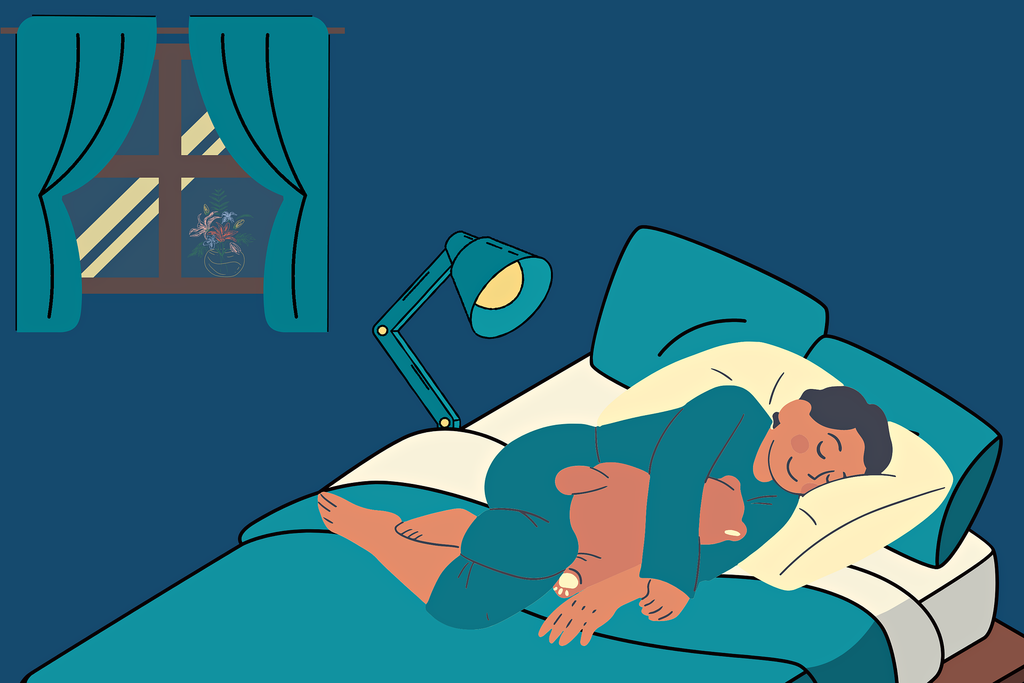
Restorative sleep is not a flat, passive state of unconsciousness. It is a highly orchestrated, active cycle where we move from light sleep into deep, slow-wave restorative sleep, and then rise into Rapid Eye Movement, or REM, sleep. Each stage has a distinct biological objective. Deep slow-wave sleep is when your body focuses on physical repair, releasing growth hormones and flushing out cellular waste from the brain. This physical cleaning is supported by the glymphatic waste-clearing cycle, which acts as a nightly plumbing system to wash away cellular debris from brain tissues.
REM sleep, by contrast, functions as the brain’s emotional filing system. During REM, your brain processes the unresolved emotional experiences of the day, stripping away the stress so you can wake up with a clean slate. But when you spend your waking hours overthinking, worrying, or locked in chronic hypervigilance, you generate an overwhelming backlog of emotional data. Your emotional filing system gets completely overwhelmed. To process this massive backlog, your brain is forced to spend excessive, unnatural amounts of time in REM sleep.
It runs high-speed survival simulations in the dream machine all night, sacrificing the deep, physically restorative stages of sleep. This is why you wake up feeling completely exhausted, even after sleeping for eight or nine hours. Your brain was running a marathon of worry while you slept, keeping your heart rate elevated and your muscles physically braced. The dream machine has overheated, burning through your vital physical resources to process the day’s unresolved fear.
This chronic adrenaline release is driven by the locus coeruleus, the brainstem’s primary noradrenergic nucleus, which fires repeatedly to signal danger and disrupt normal sleep architecture. When your system runs on high alert for too long without relief, your energy reserves deplete and the system eventually shuts down. This is the process that initiates the spiral from anxiety to depression as your system reaches a point of total physical exhaustion. You can read a deeper breakdown of this cycle in my [post on how hypnotherapy breaks the cycle of anxiety, trauma, and depression.
The Physical Logic Gap in Sleep Recovery
One of the most exhausting aspects of chronic anxiety is the realisation that you cannot think your way out of a physical state. You know, on a logical level, that your bedroom is safe and that the tasks of the coming day are not matters of survival. Yet, the moment your head hits the pillow, your heart begins to hammer, your chest tightens, and your mind spirals. This discrepancy exists because understanding a problem and resolving it are two completely different neurological events.
Your conscious mind operates only about five to ten percent of your total behaviour, running on language, logic, and willpower. The remaining ninety to ninety-five percent of your behaviour is controlled by your unconscious mind and the autonomic nervous system. Your analytical mind operates only a fraction of your total behaviour. When a physical trigger fires, it bypasses conscious reasoning entirely, which is why you cannot talk yourself out of trauma or a phobia and what actually works.
When your nervous system has been conditioned to treat rest as unsafe, your unconscious reads the quiet of the bedroom as a vulnerability. It triggers a physical alarm that completely bypasses your rational prefrontal cortex. You cannot reason with a physical reflex at three o’clock in the morning. Handing an analytical, anxious person a cognitive worksheet during a panic loop is like writing a polite letter to an engine, explaining that it should stop making a knocking sound. It is the wrong tool for the job.
To release these automatic loops, we must step back from hyper-logic and learn to use a simple, logical tool to slice through catastrophic projections (Occam’s Razor). Occam’s Razor is a philosophical principle stating that among competing explanations for the same event, the simplest explanation, the one requiring the absolute fewest assumptions, is usually the correct one. Anxiety is an incredibly efficient catastrophe-building machine, taking a single, neutral bit of data, such as a brief email or a change in schedule, and building an elaborate story of ruin. Occam’s Razor slices through this loop with a simple, grounded alternative (they were simply busy). By bringing strict simplicity to what we observe, we take our foot off the mind’s accelerator, stopping the loop before it floods the body.
Resetting the Unconscious Foundation with Hypnotherapy
To bridge the gap between logical understanding and physical release, we must communicate directly with the unconscious. This is where hypnotherapy becomes a vital intervention. During your normal waking hours, your brain operates predominantly in beta waves (a state of alert, critical analysis, and logical processing). This is the realm of the inner critic, where we scan for danger and pick our own performance apart in real time.
In this alert beta state, our unconscious defenses are on high guard. When we enter the hypnotic state, we deliberately downshift our brainwave activity. We move from waking beta waves down to relaxed alpha waves, and eventually into theta waves. Theta is a slow, highly receptive brainwave frequency associated with deep relaxation, dreaming, and the twilight zone before sleep. Crucially, from birth until the age of seven (the period known as the imprint period), a child’s brain operates predominantly in this theta state.
This is when our early survival maps, boundaries, and unconscious associations were first written. During this imprint period, we do not analyse our environment; we swallow it whole. If you grew up in a chaotic, critical, or unpredictable family system, your unconscious learned to equate vigilance with safety. Because these protective baselines were written long before you had the logical tools to challenge them, resolving them requires updating the software of the younger self that still feels unsafe. Explore how this reparenting process works on my inner child healing hypnosis page.
By accessing this exact same theta frequency through hypnotherapy, we can communicate directly with the unconscious mind. We bypass the critical, analytical barriers of the conscious mind, allowing us to update the outdated survival map that has been running on your hard drive. We replace the ancient panic responses with deliberate, safety-oriented associations. By working below the surface, we stop arguing with the reflexes.
We use metaphors, physical safety signals, and visual re-scripting to show the unconscious that the past danger has passed, and that it is safe to drop its guard. This direct, body-based communication is what collapses the automatic survival response, allowing your mind and body to genuinely rest.
The Science of Unconscious Safety (Clinical Studies and Research)
To prove that the hypnotic state is a genuine, measurable biological intervention rather than alternative mysticism, let us look at the objective science. Over the past two decades, neuroimaging and clinical trials have matured significantly, providing clear, functional proof of how hypnosis alters the brain and resets automatic physical habits.
A landmark neuroimaging study conducted by Stanford University School of Medicine researchers, led by psychiatrist Dr. David Spiegel, scanned the brains of subjects during clinical hypnosis using functional magnetic resonance imaging, or fMRI. The scans revealed three distinct, reproducible changes in brain activity. First, they observed a dramatic reduction in functional connectivity between the dorsolateral prefrontal cortex (the seat of our critical, analytical mind) and the default mode network, which is the neural pathway responsible for the background worry loop and catastrophic mind-wandering.
This represents the physical quieting of the inner critic. Second, the Stanford scans showed a significant decrease in activity within the dorsal anterior cingulate cortex, or dACC, which acts as the brain’s physical alarm system and threat-monitoring hub. This neurobiological shift proves that hypnosis is a genuine, measurable state that opens a receptive window, allowing us to bypass analytical barriers and downregulate the nervous system’s survival alarm directly at its source. This central downregulation has a direct, profound impact on systemic muscle tension and biochemistry. When experiences are filed as still active, your brain treats memory as a live alert rather than history. To understand this filing system, read my guide on how the brain stores trauma and how hypnotherapy can help you heal.
Further validation of this body-based approach comes from research on affect labelling. A landmark fMRI study conducted by Dr. Matthew Lieberman at UCLA, published in *Psychological Science*, proved that putting your physical sensations and feelings into simple, neutral words physically disrupts amygdala activity. The fMRI scans showed that labelling your state in real time decreases activity in the brain’s emotional alarm centres while increasing activity in the right ventrolateral prefrontal cortex. This simple linguistic hand-off from reactive survival regions to the logical brain is a biological intervention that calms your physical threat response.
This biological shift is also reflected in the stress biochemistry of EFT (Emotional Freedom Technique) tapping. A landmark randomized controlled trial published in *The Journal of Nervous and Mental Disease*, led by researcher Dawson Church, measured salivary cortisol levels in subjects before and after tapping. They discovered that a single hour-long session of EFT tapping physically slashed circulating cortisol levels by over twenty-four percent, significantly outperforming traditional talk therapy and quiet rest. This was replicated in 2020 by Dr. Peta Stapleton at Bond University, showing a forty-three percent reduction, proving that body-based interventions downregulate stress biochemistry.
Finally, we must integrate the power of mental visualization, which operates through a neurological phenomenon known as motor simulation. In a famous study conducted by Australian psychologist Dr. Alan Richardson, participants who practiced basketball free-throw shooting only through mental visualization improved their accuracy by twenty-three percent. This was an almost identical gain to the twenty-four percent achieved by the group that physically practiced. When you vividly visualize relaxation while keeping your body relaxed under hypnosis, your brain activates the exact same motor pathways and prefrontal areas, reinforcing composure. To your unconscious mind, a vividly imagined rehearsal is a real physical event, providing your nervous system with a successful, completed safety run. To permanently settle the background tension that triggers morning exhaustion, explore how we reset these automatic physical habits through hypnotherapy for anxiety.
Practical Nighttime Resets to Quiet the Alarm
To transition safely from daily vigilance into genuine rest, you must use body-based safety signals to turn off the survival alarm from the bottom up. By consistently sending these physical signals before sleep, you teach your brainstem to release the automatic clenching and tension loops. These practical protocols can be implemented tonight:
- Extended Exhalations: Ensure your exhalation is twice as long as your inhalation (for example, inhale for a count of four, and exhale slowly through slightly pursed lips for a count of eight). This physical rhythm stimulates the vagus nerve, which runs from your brainstem down through your major organs, sending a direct, measurable “all clear” signal to your threat-detection centres. It slows your heart rate and relaxes your muscles, interrupting the climb toward nighttime panic. This is supported by a randomized controlled trial led by Dr. David Spiegel and Dr. Andrew Huberman at Stanford University School of Medicine, published in *Cell Reports Medicine* in 2023, which found that cyclic sighing with an extended exhale outperformed mindfulness meditation for reducing physiological arousal and slowing resting respiratory rate.
- Softening Visual Focus: When your threat-detection system registers danger, your visual focus instantly narrows into a tight tunnel (foveal vision) to track the threat. To break this visual panic, soften your gaze and let your awareness spread outward to the left and right, taking in the full width of the room without moving your head. Expanding your peripheral vision tells your brainstem that there is no predator to track, pulling your system out of survival mode and proving that the bedroom is secure.
- Tactile Grounding: Settle your physical weight into your mattress and notice three distinct points of contact: the pressure of your shoulders, the support under your lower back, and the temperature of the air on your face. This simple interoceptive focus feeds your insular cortex concrete, present-tense data, helping the brain differentiate between what is actually happening now (which is safety) and what it is anticipating (which is danger).
By combining these physical safety signals, you can release the automatic loop of nighttime tension and give your mind and body permission to stand down. You are no longer that helpless child who had to remain hypervigilant to survive; you are safe.
Frequently Asked Questions About Hypervigilance & Sleep Exhaustion
Q: Why does traditional sleep hygiene fail for chronic anxiety?
A: Traditional sleep hygiene assumes that your inability to rest is simply a behavioral habit problem. It asks you to control your environment by cutting screens, adjusting temperatures, or drinking herbal teas. But chronic anxiety is not a habit problem: it is a persistent, physical threat response. When your brainstem’s alarm is stuck in the ‘on’ position, your nervous system believes there is a predator in the room. Trying to force yourself to sleep through rigid conscious rules is like trying to reason with an engine to stop it from knocking. It is a logical approach to a biological alarm, which only increases your subconscious vigilance.
Q: Why do I wake up exhausted even after sleeping for eight hours?
A: This exhaustion is caused by ‘REM sleep overheating’. When you spend your day overthinking, worrying, or in a state of high alert, you enter the night with a massive backlog of emotional data. Your brain’s emotional filing system (REM sleep) has to work twice as hard to process this stress, running high-speed survival simulations in your dreams. To keep the dream machine running, your brain sacrifices deep, slow-wave restorative sleep, which is when physical recovery actually happens. You wake up feeling like you ran a marathon because, neurologically and physically, your body was braced on a battlefield all night.
Q: Why can’t I logically talk myself out of feeling anxious at night?
A: Your conscious mind only runs about five to ten percent of your total behavior. The remaining ninety to ninety-five percent is managed below the surface by your subconscious mind and the autonomic nervous system. The part of your brain that fires the threat-response (the amygdala) does not process clinical language, logical arguments, or conscious willpower. You cannot negotiate with a physical reflex at three o’clock in the morning. To stop the anxiety, you must communicate with the subconscious and the body using physical safety signals rather than analytical reason.
Q: How does childhood hypervigilance show up in adult sleep patterns?
A: Adults who grew up in unpredictable or critical households often have an overactive Reticular Activating System (RAS) that cannot easily switch off. The unconscious mind associates the silence and darkness of the bedroom with early experiences of vulnerability or threat. Because the threat-monitoring program remains active even during sleep, the nervous system keeps the body slightly braced and fails to transition fully into deep, restorative slow-wave states, resulting in severe morning fatigue.
Q: How does hypnotherapy bypass the critical conscious mind to help you sleep?
A: Hypnotherapy works by shifting your brainwave state from alert beta waves down to relaxed alpha and highly receptive theta waves. This transition downregulates the Default Mode Network (DMN), quieting your inner self-monitoring critic and background worry loop. By communicating directly with the subconscious, hypnotherapy updates old survival plans and establishes safe, relaxed emotional associations, allowing the autonomic nervous system to release its hold on hypervigilance.
Q: Can breathing and vision exercises really change my nervous system state?
A: Yes, because they are bottom-up physical safety signals that directly affect your physiology. For example, making your exhalations twice as long as your inhalations stimulates the vagus nerve, signaling the threat centers that you are completely safe and instantly slowing your heart rate. Similarly, intentionally widening your visual focus to your peripheral boundaries breaks foveal vision (the visual tunnel used to track danger), proving to your brainstem that there is no predator in the room.
| You don’t need to have your nervous system ‘figured out’ to book this call.When your threat detection system is on high alert, even reaching out feels like a survival risk. This free 15-minute consultation is a zero-pressure, confidential space where you do not have to recount or relive any painful details of your history. We will simply map your current physical triggers, look at your sleep patterns, and see if an unconscious-level update is the right path for you.• No verbal disclosure of past history required.• Conducted safely online from the comfort of your own home.Click here to choose a quiet time on my calendar |





Leave a Reply