
A complete neurobiological guide to uncoupling active threat memories and reconditioning autonomic survival loops

For decades, the dominant approach to treating psychological wounds has been built on a single, conscious assumption: if you can talk about a problem, analyse its origins, and understand its historical timeline, you can resolve its power over your life. Traditional talk therapies, cognitive reframing, and rational analyses operate entirely from this top-down perspective, attempting to use the conscious prefrontal cortex to negotiate with deeply held emotional distress. Yet, many people who have spent years in talk therapy find themselves frustrated by a persistent mismatch. They can intellectually describe their past, outline their triggers, and understand why they react the way they do, yet their physical body continues to clench, panic, and freeze in high-stakes situations as if the danger were occurring in the present moment.
This persistent physical activation is not a sign of personal weakness, nor is it a failure of willpower or intellect. It is the result of a profound biological disconnect between conscious intellect and autonomic reflexes. When you live through a traumatic event, a severe relational shock, or a period of prolonged childhood stress, the memory of that experience is not recorded as a logical, orderly narrative. Instead, it is captured as raw physical sensations, sensory fragments, and motor reflexes stored directly in the subcortical regions of the brain and the autonomic nervous system. As a trauma-informed hypnotherapist, I offer a safer, gentler alternative that accesses the unconscious mind directly to resolve these deep-seated responses. I have spent years helping clients understand that trying to negotiate with a physical panic loop using conscious reasoning is inherently ineffective. The unconscious mind operates below the level of conscious language, and to achieve genuine resolution, we must utilise therapeutic pathways that communicate in the body’s actual language of sensation and pattern.
To make this comprehensive guide as valuable as possible, we will explore the precise neuroscience of why conscious reasoning fails to reach traumatic conditioning. We will map Joseph LeDoux’s evolutionary low road of fear conditioning, explain why high-stress biochemistry takes the rational prefrontal cortex offline mid-panic, and detail the precise mechanics of memory reconsolidation. Finally, we will show how trauma-informed hypnotherapy guides the nervous system into relaxed theta states to safely update these automatic patterns at their source, re-establishing a durable, physiological baseline of internal safety.
The Biological Mismatch of Modern Fear Responses
To understand why conscious logic fails so reliably in the face of anxiety and phobias, we must examine the evolutionary mismatch that shapes our threat-detection machinery. The human nervous system is an ancient biological apparatus, sculpted over millions of years to meet the immediate, physical survival demands of a volatile prehistoric world. In that ancestral environment, threat detection had to be absolute, instantaneous, and highly defensive. If our ancestors paused to logically analyse whether a rustle in the grass was a dangerous predator or merely a passing breeze, they would not have survived to pass on their genetics. Success required a nervous system that learned fast and generalised aggressively.
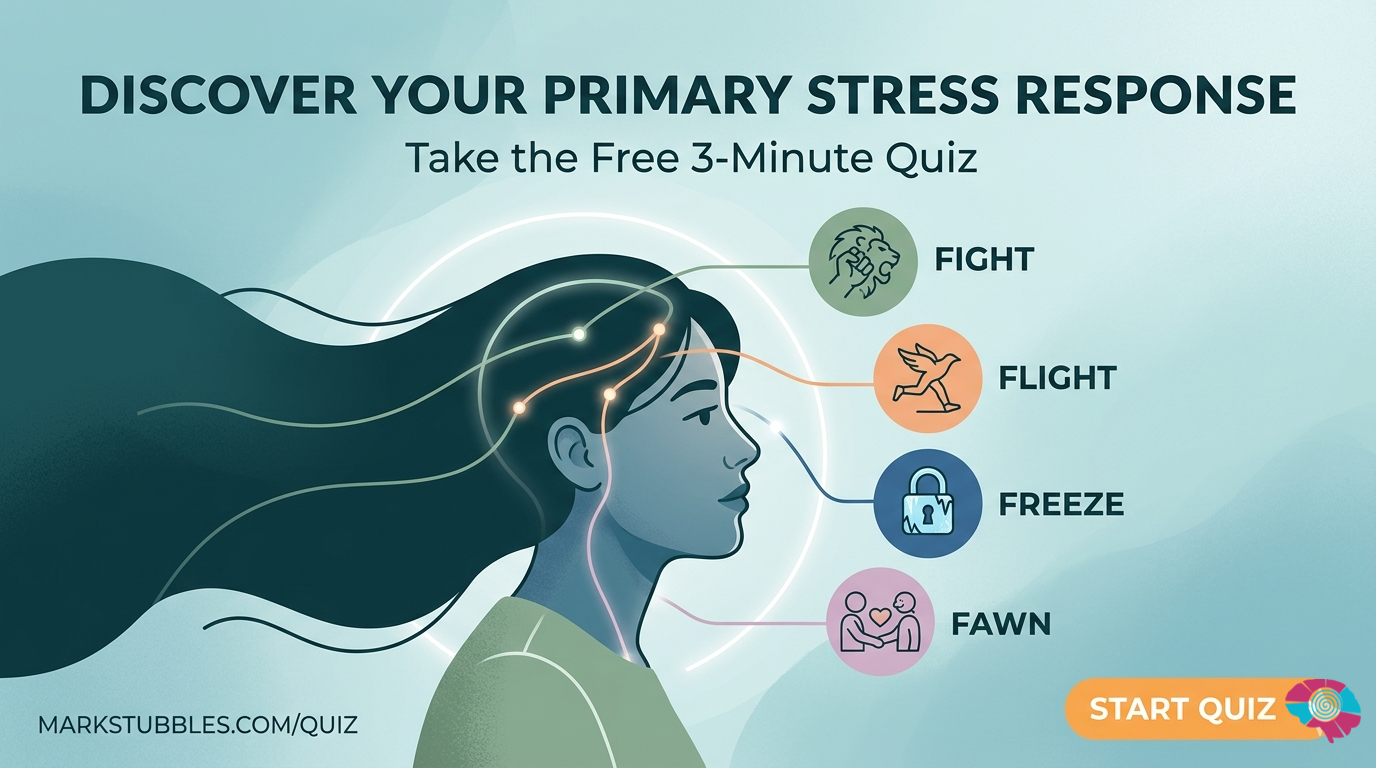
Consequently, our brains evolved to prioritise safety over logical accuracy, creating rapid, automatic reflexes that bypass conscious evaluation entirely. When a sudden threat was registered, the body immediately entered a state of sympathetic mobilisation, which accelerates the heart rate, tenses the muscles, and narrows the visual focus to prepare for immediate flight or combat, If escape was impossible, the system dropped into a dorsal vagal freeze response, a state of physical immobility and numbness designed to minimise pain and increase the odds of survival in a predator’s grip.
The profound challenge of modern life is that our ancient survival machinery is still running on the same prehistoric hard drive, but it is now forced to navigate non-lethal, symbolic environments. Modern threats (such as a presentation before colleagues, a sudden blush in a business meeting, or an unexpected merge into the fast lane of a high-speed motorway) pose zero actual threat to our physical survival. Yet, to our over-primed threat-detection system, the sensation of being observed, judged, or spatially confined registers as an immediate survival emergency. The automatic fear response fires with the same chemical intensity as if a physical predator were tracking us, flooding the body with stress hormones and taking our rational reasoning systems completely offline.
Because these primitive defensive strategies were designed to protect us from immediate physical destruction, they generalise aggressively to prevent any risk of exposure. Your phobia is not a broken personality trait, but an ancient survival reflex firing in a modern, non-lethal context. White-knuckling your way through motorway driving or trying to force yourself to calm down only increases the internal conflict, signalling to your brainstem that you are engaged in an active struggle for survival. True healing requires updating these outdated threat maps at the level where they live, which is the autonomic nervous system.
Joseph LeDoux’s Low Road of Fear Conditioning
At the heart of our autonomic threat architecture lies Joseph LeDoux’s groundbreaking work on fear conditioning, which maps how the brain routes sensory data under stress. Under normal, non-threatening conditions, incoming sensory information (such as a sight or a sound) travels to the thalamus, which serves as the brain’s central relay station. From there, the data is sent to the sensory cortex for high-resolution processing and then on to the prefrontal cortex for logical evaluation. This is known as the ‘high road’ of sensory processing. It allows you to evaluate your environment calmly and respond with conscious, balanced decision-making.
However, when a sensory signal contains cues that the brain has previously associated with extreme danger, the thalamus takes a biological shortcut. It routes the raw, unprocessed sensory data directly to the amygdala (the brain’s primary smoke detector and threat-monitoring hub), completely bypassing the slower cortical networks. This rapid, subcortical pathway is what LeDoux termed the ‘low road.’ Because the low road is shorter and requires fewer synaptic connections, it registers a threat and triggers a massive physiological response in a matter of milliseconds. This rapid activation is what allows you to leap out of the way of an oncoming vehicle or jump back from a slithering shape before your conscious mind has even registered what you are looking at.
While this subcortical shortcut is vital for physical survival, it creates a massive therapeutic challenge when dealing with conditioned fear responses like social anxiety, blushing, or motorway panic. When a trigger is touched, your amygdala pulls the alarm, activating the hypothalamus and adrenal glands to flood your system with catecholamines (adrenaline and norepinephrine). This surge occurs long before your rational prefrontal cortex can evaluate the situation. Because this response is executed by primitive subcortical motor networks that bypass the analytical cortex entirely, you cannot use logical self-talk to stop an active panic loop. The alarm has already fired, and your body is locked in a survival state before your thinking brain can even formulate a sentence.
Why Conscious Logic Fails Mid Panic
When the survival alarm is pulled, the physiological consequences make it virtually impossible to think your way out of the crisis. Neuroscientist Amy Arnsten’s extensive research on stress physiology demonstrates that high levels of adrenaline and cortisol temporarily take the rational prefrontal cortex completely offline. This is a highly adaptive evolutionary feature: in a life-or-death scenario, you do not want your brain spending precious energy resources on abstract thinking or philosophical analysis. You want all available energy directed to the subcortical motor networks that control immediate physical action.
Consequently, when you find yourself in the grip of acute anxiety, the very brain regions responsible for logic, language, and cognitive control are chemically impaired. This explains why logical self-talk (such as reciting statistics about flight safety or telling yourself that your colleagues are friendly) feels completely ineffective mid-panic. The message cannot be processed because the hardware required to understand it has been temporarily shut down by stress chemistry. Trying to resolve an active panic loop with rational arguments is like writing a polite letter to an engine, explaining that it should stop making a knocking sound; it is simply the wrong tool for the job.
The Failure of Top Down Analytical Cognitive Methods
This biological impairment represents the primary limitation of traditional top-down therapeutic methods. Standard cognitive behavioural tools and talk therapies ask you to examine, document, and challenge your thoughts in the moment of distress. While this analytical approach can be highly valuable for mapping your triggers and understanding your patterns under calm conditions, it struggles to resolve autonomic reflexes during active panic. Because your prefrontal networks are offline, you cannot white-knuckle your way through a physiological threat response with conscious willpower alone.
To safely interrupt the climb toward acute panic, you must speak the body’s physical language first, stabilising your physiology from the bottom up. While you cannot use your thoughts to control your heart rate or your adrenaline levels directly, you can use your breath, your eyes, and your touch to send immediate, mechanical safety signals to your brainstem. A primary bottom-up physical tool for immediate autonomic regulation is the physiological sigh panic reset, which stimulates the vagus nerve and mechanically slows the heart rate down in seconds. By consistently sending these physical safety signals, you provide your brainstem with the verifiable, present-tense proof of safety it needs to stand down, allowing your rational prefrontal cortex to naturally return online.
The Active Threat Folder and Memory Filing Failures
To understand how trauma and phobias endure for years, we must look at how the brain processes and files memory under extreme stress. Under normal, safe conditions, your brain’s primary memory filing system, the hippocampus, is responsible for organising, contextualising, and dating your everyday experiences. When the hippocampus is functioning well, it places a clear timestamp on your memories, filing them away in your brain’s historical archives as events that happened in the past, rather than things that are still occurring.
However, during overwhelming threat or traumatic stress, high levels of adrenaline and cortisol disrupt normal hippocampal function. If the nervous system enters a protective dorsal vagal freeze or shutdown state, the brain’s ability to properly timestamp and archive memories is severely compromised. Instead of being filed away neatly, the raw sensory details and intense emotions of the event are captured by the amygdala and stored in what functions like an active threat folder.
This distinction represents the core neurobiological mechanism of PTSD, chronic anxiety, and phobias. A memory stored in the historical archive produces a mild, appropriate emotional response when recalled: you remember that the event was difficult, but you are physically aware that it is over. In contrast, a memory stored in an active threat folder is treated by your brain as a live alert. Whenever a sensory trigger matches a snapshot in that folder, your amygdala fires immediately, flooding your body with stress hormones and triggering a full survival-mode panic loop. Your brain treats the memory as if it is happening right now, in the present, because nobody has told your unconscious mind that the danger has passed. If you would like to explore this memory filing system in greater detail, you can read my guide on how memories are filed as active threat cues.
Safe Memory Reconsolidation in Theta State Hypnotherapy
Fortunately, neuroscience research has proven that memories are not fixed, permanent structures once formed. Every time you recall a memory, it enters a temporal window of vulnerability where it becomes malleable and flexible before being stored again. This natural biological process is known as memory reconsolidation. It represents a major opportunity for healing: by accessing a memory under the correct physical conditions, your unconscious mind has the ability to update its emotional content, weakening the alarm tag and re-storing it with new associations of safety attached.
This neurobiological process is precisely how hypnotherapy facilitates deep, lasting trauma resolution. During normal waking hours, your brain operates predominantly in alert beta waves (which represents a state of active, critical analysis, and logical processing). While this state is useful for daily tasks, it is also the realm of the analytical inner critic, where our unconscious defences are on high guard. When we enter the hypnotic state, we downshift our brainwave activity into relaxed alpha and highly receptive theta wave states. Theta is a slow, deeply relaxed brainwave frequency characterised by quiet focus and receptivity. Crucially, it is the exact frequency in which our first survival maps, boundaries, and unconscious associations were originally formed during early childhood.
By accessing this theta frequency through hypnotherapy, we can communicate directly with the unconscious mind, bypassing the critical, analytical barriers of the conscious mind. While holding the traumatic memory in this deeply relaxed, physically safe state, your brain receives a safe mismatch signal. It realises you are remembering the difficult event, but your physical body is signalling that you are completely safe. This mismatch uncouples the panic and fight-or-flight response from the memory, allowing your hippocampus to finally file the experience away in your brain’s historical archives. The facts of your past do not change, but the emotional sting is permanently gone.
Dismantling Childhood Conditioning and Toxic Shame
When a child grows up in an unpredictable, critical, or emotionally cold family system, they do not possess the logical tools to contextualise their environment. A child cannot conclude that their primary caregivers are flawed, wounded, or struggling with their own unhealed issues. Instead, the child’s developing mind draws a simple, self-referential conclusion: ‘If my caregivers are angry, cold, or unpredictable, it must be because I am bad, unlovable, or inherently faulty.’ This is the origin of toxic shame, which is a persistent, crushing sense of unworthiness that is swallowed whole and stored deep in the unconscious mind.
Landmark neuroimaging research conducted by Dr. Martin Teicher at Harvard Medical School demonstrates that early childhood stress physically sculpts brain development, leading to reduced volume in the prefrontal cortex and left hippocampus, alongside an overactive, hyper-responsive amygdala. Because this threat-detection architecture is physically constructed during childhood, adult triggers bypass rational cognitive pathways entirely. For adults who grew up in dysfunctional households, this manifests as chronic hypervigilance, an overactive Reticular Activating System (RAS) that constantly scans social environments for signs of rejection, and a cruel, internalised critical voice.
This protective conditioning often drives automatic relational responses, such as people-pleasing, perfectionism, or fawning. Healing these patterns requires more than intellectual analysis in talk therapy. It requires a gentle, bottom-up approach that enters the relaxed theta brainwave states where these early world maps were first formed. Through inner child hypnotherapy, we can communicate directly with the younger parts of yourself, offering them the physiological safety, attunement, and unconditional acceptance they never received. By reparenting the younger self under hypnosis, we can safely clear the toxic shame, break the trauma bonds, and establish a lasting baseline of internal safety.
High-Pressure Situations
The underlying automatic neural loop remains identical across all situational phobias: the amygdala flags a threat, the memory is stored in an active threat folder, the polyvagal hierarchy mobilises your systems, and the brainstem generalises the trigger to expand your avoidance patterns. This same physical architecture shows up in multiple high-stakes situations on your website:
Vehicular and Motorway Phobias
The feeling of entrapment and a lack of perceived exit on high-speed roads triggers sudden sympathetic mobilisation, followed by a dorsal vagal freeze response that manifests as brain fog, heaviness, and spatial disorientation. I break down this exact physical loop in my guide on the neuroscience of highway panic.
Travel and Aviation Panic
Flying encapsulates the ultimate state of confinement, pairing a highly triggered threat response with an absolute inability to physically escape until the plane lands. Explore how to uncouple these confinement triggers in my overcoming fear of flying guide.
Acute Medical and Dental Anxiety
Facing clinical procedures, surgeries, or dentist appointments triggers anticipatory muscle bracing, jaw clenching, and vasovagal responses as your brain stem scans the environment for sensory threats. Learn how to reset your threat filters in my dental phobia hypnosis treatment and my overcoming medical phobia guide.
Whether your anxiety is situational, like driving and flying, or social, like blushing, sweating, and public speaking, the physical loop is the same. Understanding this common thread allows you to stop fighting individual symptoms and address the nervous system as a whole. To learn how to maintain vocal control and relaxed focus before an audience, read my complete guide on Command the Room with Authentic Unconscious Presence.
Comparing Cognitive Analysis and Unconscious Rewiring
To bring complete clarity to how these approaches differ, let us examine the core therapeutic parameters that separate standard, top-down cognitive methods from bottom-up, unconscious reconditioning. Talk therapies focus primarily on the conscious, logical mind, attempting to use language and worksheets to manage symptoms. While this can build valuable intellectual insight, it leaves the deep autonomic panic reflexes completely untouched. In contrast, trauma-informed hypnotherapy operates directly within the relaxed brainwave frequencies where early conditioning is held, allowing your nervous system to register safety at its source.
| Therapeutic Parameter | Traditional Logical Approach (Top-Down) | Unconscious Reconditioning (Bottom-Up) |
|---|---|---|
| Neurological Target | Prefrontal cortex (conscious analytical networks) | Amygdala, brainstem, and unconscious motor networks |
| Processing Channel | Verbal disclosure, cognitive reframing, and rational debate | Non-verbal processing, relaxed alpha/theta wave states, and metaphor |
| Trigger Management | White-knuckling, logical self-talk, and coping exercises | Memory reconsolidation to collapse the automatic physical trigger |
| Primary Outcome | Conscious intellectual understanding but persistent body-based bracing | Autonomic physical calm and memories correctly filed as history |
Frequently Asked Questions About Trauma and Phobia Resolution
Why does conscious logic fail to stop automatic phobia and panic?
Conscious logic fails because phobias and panic loops are controlled by ancient subcortical brain structures like the amygdala, which operate below conscious awareness and process threat in milliseconds. When a trigger is encountered, the amygdala fires first via the subcortical low road, flooding your body with stress hormones before your rational prefrontal cortex can evaluate the situation. Because high levels of stress hormones temporarily take the reasoning centres of your brain offline, you cannot logically talk yourself out of an autonomic reflex. You must use body-based safety signals and unconscious reprogramming to quiet the alarm.
What is the difference between immediate stabilisation and permanent reprogramming?
Immediate stabilisation tools (like panoramic vision, physiological sighs, and tactile grounding) are designed to manage active symptoms in the moment by sending physical safety signals to your brainstem. They interrupt the active panic loop and help you get through high-pressure situations, but they do not alter the underlying conditioning. Permanent reprogramming, achieved through theta-wave hypnotherapy, addresses the root cause by accessing the unconscious mind, updating the old threat associations, and triggering memory reconsolidation so the nervous system stops generating the panic response in the first place.
How does early childhood stress affect adult phobia?
Growing up in an unpredictable, stressful, or emotionally dysfunctional environment shapes the physical architecture of a child’s developing brain. Chronic early stress leads to an enlarged, hyper-reactive amygdala and reduced activity in the prefrontal cortex, setting a highly sensitive baseline for the nervous system. As an adult, this overactive threat-detection system generalises aggressively, misinterpreting neutral modern situations as active survival emergencies. By utilising hypnotherapy to access the theta wave states where these early survival maps were formed, you can safely process these early emotional wounds and establish a lasting foundation of internal safety.
How does hypnotherapy bypass your critical conscious mind to resolve trauma?
Hypnotherapy bypasses your critical conscious mind by gently shifting your brainwave activity from alert beta waves into relaxed alpha and highly receptive theta waves. This transition downregulates the Default Mode Network (DMN), quieting your analytical inner critic and self-monitoring worry loops. In this deeply relaxed, focused state, your unconscious mind becomes highly receptive to positive suggestions and new safety associations. This allows a hypnotherapist to work directly with your memory reconsolidation pathways, updating the emotional tags of old protective patterns without the analytical interference of your logical mind.
Taking the Next Step Toward Freedom
If you are ready to break free from the exhausting patterns of chronic anxiety, hypervigilance, and emotional bracing, you do not have to walk this path alone. Your ancient survival systems learned to stay on high alert to protect you under extreme circumstances, but they can learn something new. The nervous system that became locked in survival loops can safely learn safety baselines at an unconscious level, allowing you to reclaim your personal freedom and exist fully in the present.
To support your healing journey at your own pace, I offer several professional guides and interactive programmes:
• eBook: If you want to understand how your Reticular Activating System (RAS) encodes anxiety and how to send safety signals from the bottom up, download my complete Unlearn Your Fear book.
• Interactive Workshop: To safely connect with and heal early emotional conditioning under professional guidance, join our upcoming live online Inner Child Pop-up Workshop.
• Unconscious Audio Reset: To privately begin the protocol of detaching emotional charges from traumatic memories at home, access my PTSD Hypnosis Download MP3 toolkit.
When you feel ready for personalised, one-on-one support, I invite you to Book a free consultation call to discuss how online hypnotherapy can help you safely update your system’s protective associations and restore deep, lasting physiological calm.





Leave a Reply