

When most people talk about depression, they describe it as a dark cloud, a heavy weight, or a mysterious chemical imbalance that arrives out of nowhere. They treat it as a pure thinking problem or a defect in the brain. That approach ignores how the body and mind actually work together.
Depression rarely exists in a vacuum. In practice, depression is almost always the secondary result of an overloaded nervous system. It is the endpoint of chronic anxiety, unaddressed childhood trauma, and a mind that has spent years running in survival mode until it simply runs out of fuel.
If you have tried medication, traditional talk therapy or self-help books and still feel stuck in a low, flat state, it is not because you are faulty. It is because you are treating a subconscious state with conscious, logical effort.
To break out of depression, you have to understand how your nervous system got you here, why your brain filters for negativity, and how hypnotherapy rewires the underlying mechanics that keep you trapped.
The Spiral from Anxiety to Depression
Many people view anxiety and depression as two completely separate conditions. You are either high-strung and panicked, or you are sluggish and hopeless. In reality, they are two sides of the same coin. Anxiety is the acceleration; depression is the crash.
The Survival Loop
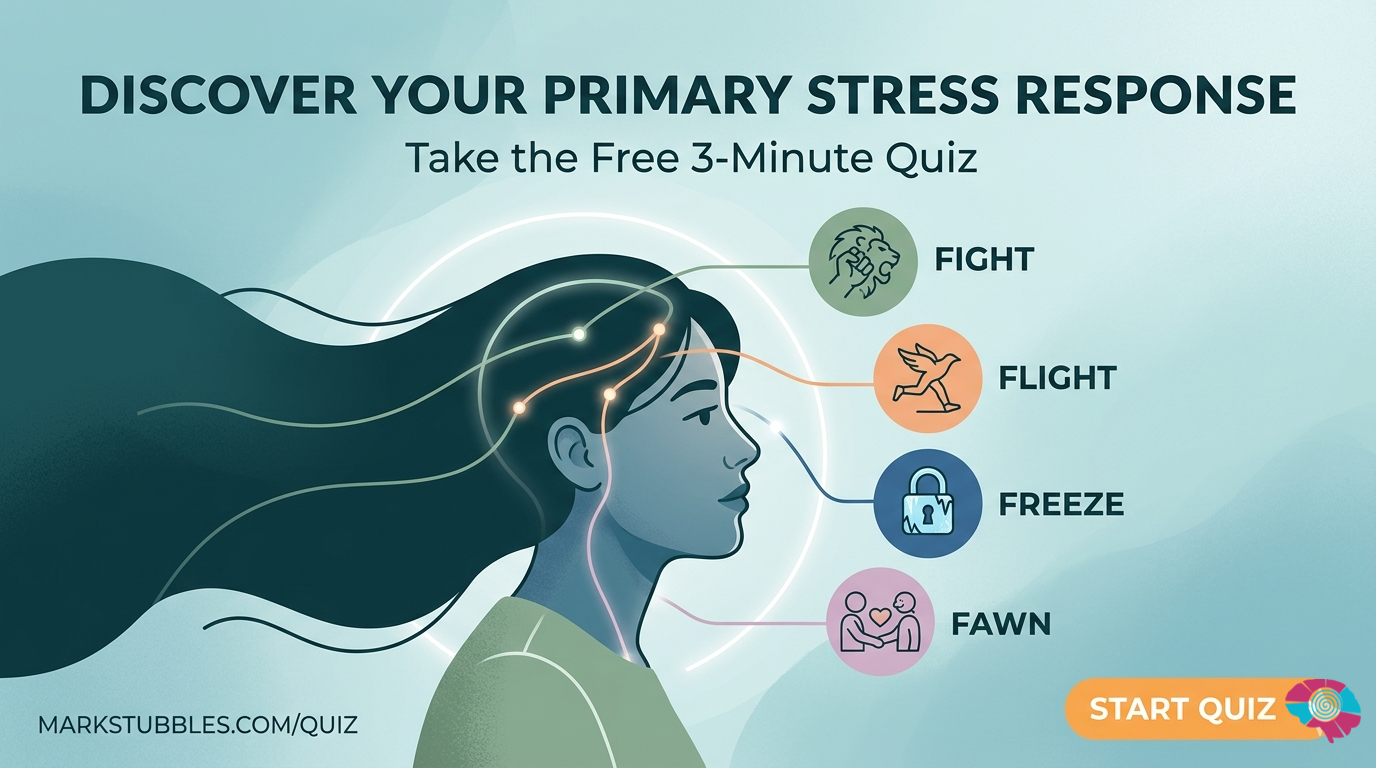
Anxiety is a natural physical response to perceived danger. When your brain senses a threat, it triggers the fight-or-flight response. Your heart rate surges, your breathing becomes shallow, your muscles tense up, and your body pumps stress hormones like cortisol and adrenaline into your bloodstream. I go into what anxiety is and how hypnotherapy can help with chronic anxiety here.
Anxiety is designed for short bursts of physical activity, like running away from a predator. But modern stressors are not short-lived. Financial stress, workplace tension, relational conflict, and unresolved past experiences keep the body locked in fight-or-flight for weeks, months, or years.
Running an engine at the redline continuously causes the system to overheat and shut down. That shutdown state is what we recognize as depression.
| Stage | Nervous System & Physical Mechanism |
|---|---|
| 1. Chronic Anxiety | Constant fight-or-flight activation, elevated cortisol, hyper-vigilance. |
| 2. Social Withdrawal | Systematic isolation, shrinking social circle, avoiding perceived triggers. |
| 3. Loss of Meaning | Absence of positive feedback loops, flat affect, depleted physical energy. |
| 4. Depression | Full system shutdown, nervous system freeze response, subconscious trap. |
How Avoidance Shrinks Your World
When you live with chronic anxiety, your primary objective becomes avoiding discomfort. You stop going to social gatherings because your chest feels tight around groups. You pass up promotions because your throat closes up when you have to present in a meeting. You decline invitations, spend more time alone, and stay within a narrow zone of comfort. This safety seeking comes at a steep price:
Isolation: Your social circle shrinks. Human beings are hardwired for connection; long periods of isolation signal to the subconscious mind that you have been abandoned by the tribe, which triggers a deep physical sense of threat.
Loss of Positive Feedback Loops: When you stop taking action, going out, and trying new things, your brain stops producing dopamine. You give yourself zero opportunities to experience mastery, pleasure, or surprise.
Rumination: Without external stimulation, your attention turns inward. You sit in a chair and replay past mistakes, awkward interactions, or future worries on a loop.
By protecting yourself from the panic of anxiety through avoidance, you inadvertently build the exact environment required for depression to thrive. Depression is the physical debt of chronic, unmanaged anxiety.
The Physical Reality of Depression
Depression is not just feeling sad. Sadness is an emotion. Depression is a physical state of hypo-arousal, often referred to as the “freeze” response. When your conscious mind gives up on trying to fight or run away from a situation, the parasympathetic nervous system takes over in an extreme way. It slams on the brakes to conserve energy and protect you from further pain.
What Depression Looks Like in the Body
If you pay attention to the physical signals of depression, you will realize it is a full-body experience:
The Heavy Chest and Flat Breathing: Your lungs take in minimal air. Shallow breathing starves your tissues of optimal oxygen, leaving you feeling physically exhausted before you even get out of bed.
Locked Jaw and Slouched Posture: Your shoulders curve forward, your chin dips down, and your chest caves inward. This is a classic defensive posture designed to protect your vital organs from attack.
Brain Fog: Your head feels like it is stuffed with cotton. Clear decision making becomes impossible because the brain is conserving energy for basic physiological maintenance.
Gastrointestinal Issues: The nervous system and the gut are connected via the vagus nerve. When you are stuck in a freeze state, digestion slows down or malfunctions, leading to chronic stomach issues, bloating, and fatigue.
The Role of REM Sleep and Morning Fatigue
A common symptom of depression is waking up feeling completely exhausted, even after sleeping for eight or nine hours. You step out of bed and your legs feel like lead.
This exhaustion is directly tied to how your brain processes emotional stress while you sleep.
Dreams occur primarily during Rapid Eye Movement (REM) sleep. The evolutionary purpose of REM sleep is to process unresolved emotional experiences from the day, stripping away the stress so you wake up with a clean emotional slate.
When you spend your waking hours ruminating, worrying, and suppressing negative emotions, you give your brain an overwhelming backlog of emotional data to process. As a result, your brain spends far too much time in REM sleep during the night.
| Sleep Profile | Nighttime Cycle | Morning Result |
|---|---|---|
| Normal Sleep Cycle | Light Sleep → Deep Restorative Sleep → Balanced REM | Waking refreshed and physically recharged |
| Depression Sleep Cycle | Light Sleep → Excessive REM (Overheating) → Minimal Deep Sleep | Waking exhausted with physical leaden fatigue |
Excessive REM sleep drains huge amounts of energy. Deep, physical restorative sleep is sacrificed to keep the dream machine running. You wake up in the morning feeling as though you spent the entire night running a marathon, because mentally, you did. That morning exhaustion reinforces the belief that you cannot face the day, driving you right back under the covers and deepening the depression loop.
The Reticular Activating System (RAS) and Threat Filtering
To understand why depression feels so inescapable, you have to look at how the brain filters information from the outside world. At the base of your brain sits a small, walnut-sized network of neurons called the Reticular Activating System (RAS).
The RAS acts as the gatekeeper of your conscious awareness. At any given second, your senses are bombarded with roughly 11 million bits of information. Your conscious mind can only process a tiny fraction of that data, usually around 40 to 50 bits per second. The RAS decides what gets through to your awareness and what gets ignored.
How the RAS Gets Programmed
Your RAS filters information based on what it believes is important for your survival. It is programmed by three main factors:
Past Traumatic Experiences: High-emotion events reprogram the RAS instantly. If you experienced childhood neglect, sudden loss, or prolonged emotional abuse, your RAS sets its default setting to “scan for danger and rejection.” Understand how your brain stores traumatic memories.
Repetitive Self-Talk: The internal monologue you run every day gives direct orders to the RAS. If you repeat, “I can’t handle this,” “Nothing ever works out,” or “I am completely exhausted,” the RAS treats those statements as search queries.
Current Emotional State: If you are in a depressed state, your RAS actively suppresses positive input and highlights negative input.
Confirmation Bias in Action
If you sit in a room with your RAS set to a depression filter, here is how it operates:
You walk into a room of ten people. Nine of them smile at you, and one person looks away with a neutral expression. Your RAS completely ignores the nine smiling faces and forces your attention onto the single person who looked away. You receive five compliments on a project at work and one mild critique. Your brain discards the praise as fake or irrelevant and spends three days replaying the critique.
You are not consciously choosing to be pessimistic. Your RAS is literally preventing you from seeing evidence that contradicts your current state. You cannot simply “think positive” out of this state, because your brain filter will not even let positive evidence reach your conscious mind.
To change what you notice, you have to reset the filter at a subconscious level.
The Limitations of Talk Therapy and Conscious Effort
When people realize they are stuck in depression, the standard response is to try to talk or reason their way out of it. They book traditional talk therapy, buy self-help workbooks, or force themselves to repeat positive affirmations in the mirror.
While these approaches are well-intentioned, they often run into a hard structural wall.
The 5% vs. 95% Problem
The human mind is functionally split into two operating systems:
| Mind Level | Percentage | Primary Functions & Mechanisms |
|---|---|---|
| Conscious Mind | ~5% | Logic, reasoning, willpower, critical analysis. Tries to “think positive” or analyze past events intellectually. |
| Subconscious Mind | ~95% | Autonomic nervous system, RAS threat filtering, somatic memory. Controls emotional patterns, survival reflexes, and muscle tension. |
The conscious mind operates using logic and willpower. It is where you make plans, analyze data, and decide you want to feel better. But it only controls a tiny fraction of your total brain activity.
The subconscious mind controls everything else: your autonomic nervous system, your heart rate, your hormonal balance, your implicit memory, and your deeply ingrained survival patterns.
When you sit in a room and talk logically about your depression, you are engaging the 5% conscious mind to try and debate the 95% subconscious mind.
If your subconscious mind has decided that shutting down your energy (depression) is the safest way to protect you from stress or hurt, no amount of logical debate will convince it otherwise. Willpower is a limited daily resource; the moment you tire out, the subconscious default settings take over again.
Why Affirmations Fail
Positive affirmations often backfire for people dealing with real depression. If you feel a knot in your gut and a heavy, hopeless ache in your chest, standing in front of a mirror and saying, “I am vibrant, happy, and full of energy” creates immediate cognitive dissonance.
Your critical mind steps in and rejects the statement as a lie. Worse, it signals to your subconscious that you are lying to yourself, which increases internal tension and reinforces the feeling that something is deeply wrong with you.
You cannot force an update to your subconscious software using surface-level conscious statements. You have to communicate with the subconscious using its own language.
How Hypnotherapy Works to Resolve Depression
Hypnotherapy is not magic, stage entertainment, or losing control of your mind. It is a precise, grounded clinical tool that uses a state of focused attention to communicate directly with the subconscious operating system.
When you enter a hypnotic state, your brain wave activity shifts from fast beta waves (active, analytical conscious thinking) down to alpha and theta waves (deep relaxation, heightened internal focus, and subconscious plasticity).
| Brain Wave State | Frequency | Characteristics |
|---|---|---|
| Beta | 14–30 Hz | Active, analytical, stressed daily waking state (High critical filter). |
| Alpha | 8–13 Hz | Relaxed focus, calm meditation, light trance (Filter begins to drop). |
| Theta | 4–7 Hz | Deep hypnotic trance, direct subconscious access (High neuroplasticity). |
Watch the Live Workshop & Experience the Hypnosis Session
In this recorded live workshop, I break down the exact connection between anxiety, trauma, and depression, answer live Q&A, and lead a guided hypnosis session designed to help quiet negative mental loops.
By bypassing the critical analytical filter, hypnotherapy allows us to work directly with the nervous system patterns, somatic memories, and RAS programming driving the depression.
Here is how professional hypnotherapy targets depression at the root level:
1. Regulating the Autonomic Nervous System
Before any emotional work can happen, the physical body must be brought out of the freeze state.
During hypnotherapy, guided sensory focus, somatic awareness, and altered breathing patterns signal safety directly to the vagus nerve. This lowers heart rate variability, relaxes chronic muscle tension in the jaw and chest, and brings the nervous system out of hypo-arousal.
You cannot think your way into feeling safe; you must feel safe physically before your brain will allow you to drop the depression defense.
2. Reprogramming the RAS via Experiential Visualization
The subconscious mind does not distinguish clearly between a real, physically experienced event and a vividly imagined sensory experience.
If you sit in a chair and vividly picture yourself handling a situation with calm authority, feeling the physical sensation of relaxed shoulders, easy breathing, and a clear mind, your brain fires the exact same neural pathways as it would if you were physically doing it.
In hypnosis, we use this mechanism to actively reprogram your Reticular Activating System:
We guide you through sensory-rich mental rehearsals of taking effective action, stepping out into social situations, and feeling physical vitality. This builds brand-new neural pathways in the brain, creating a track record of success that the RAS can use as a reference point.
Over repeated sessions, the RAS shifts its filter. It stops scanning exclusively for threats and failures and begins picking up on opportunities, solutions, and positive cues in your daily environment.
3. Clearing the Underlying Emotional and Trauma Drivers
Depression is often a protective wall built over old, unaddressed emotional material, such as childhood trauma, emotional neglect, or past losses that were never properly processed.
In a waking state, reaching those memories triggers immediate panic, causing you to pull back or dissociate.
Under hypnosis, because the body is deeply relaxed and safe, you can access those implicit memories without being overwhelmed by the survival alarm. Hypnotherapy allows you to:
Identify the original events where your subconscious first learned that shutting down was the safest option. Process the trapped emotional charge safely within the body. Re-frame those events from an adult perspective, teaching the subconscious that the past danger has passed and that the defensive depression protocol is no longer required.
4. Interrupting the Excessive REM Sleep Loop
By using hypnotherapy to process emotional stress and discharge nervous system arousal during the day, we drastically reduce the emotional backlog your brain has to handle at night.
As a result:
Your brain spends less time in excessive, draining REM dream states. You spend more time in deep, restorative delta-wave sleep. You wake up in the morning with actual physical energy, breaking the cycle of morning exhaustion and hopelessness.
Practical Somatic Interventions You Can Start Today
While professional hypnotherapy is the fastest route to updating subconscious programming, you can start making immediate adjustments to your physical state today.
Because the body and mind exist in a continuous feedback loop, altering your physical inputs forces a change in your mental processing.
The Posture and Physiology Shift
Systems theory states that changing one part of a system automatically alters all other parts. You cannot maintain a deep depression response in the subconscious while your body is giving explicit physical signals of power and safety.
Try this practical reset right now:
Un-collapse the Frame: Stand up or sit up straight. Unfurl your shoulders and slide them back and down away from your ears. Open up your chest.
Change Your Visual Field: Depression causes your eyes to fixate downward on the floor just a few feet in front of you, narrowing your visual field. Raise your chin, look up, and deliberately look out at the horizon or the far corners of the room. Expanding your visual space triggers a nervous system shift out of fight-or-flight.
Extend the Exhale: Take a slow breath in through your nose for four seconds, letting your stomach expand rather than your upper chest. Then, exhale slowly through your mouth for six to eight seconds. Extending the exhale directly stimulates the vagus nerve, slowing your heart rate and interrupting the physical panic or freeze signal.
The Gratitude Journaling RAS Reset
To start manually resetting your Reticular Activating System without a therapist present, use focused, written inputs every morning.
This is not about vague positive thinking. It is an exercise in training your brain’s search engine:
Every morning, write down five specific physical things you are looking forward to or grateful for that day. Keep them simple and concrete: the taste of hot coffee, the sun hitting your desk, a walk around the block, or a text from a friend. As you write each one down, pause for ten seconds and actively focus on the physical sensation in your body when you think about it.
By forcing your brain to identify five concrete items every morning, you give your RAS explicit instruction to search for similar inputs throughout the rest of the day.
What Clinical Research Shows
While many people still view hypnotherapy as an alternative or fringe approach, modern clinical research consistently demonstrates its effectiveness for mood and anxiety disorders.
- Superior Outcomes Over Talk Therapy Alone: A randomized controlled trial published in the American Journal of Clinical Hypnosis (Alladin & Alibhai) compared standard Cognitive Behavioral Therapy (CBT) against Cognitive Hypnotherapy. The group receiving hypnotherapy alongside CBT showed significantly greater reductions in depression and anxiety, maintaining those gains at 6- and 12-month follow-ups.
- Large-Scale Evidence: A major meta-analysis (Milling et al.) evaluating hypnotic interventions for depressive symptoms found that participants receiving hypnotherapy experienced greater symptom improvement than roughly 76% of control participants.
- Direct Comparison to Standard Treatments: Recent clinical trials (such as Fuhr et al.) evaluating standalone hypnotherapy for major depressive episodes confirmed that structured hypnotherapy is non-inferior to gold-standard CBT in reducing depressive symptoms.
The research confirms what we see in practice: when you combine cognitive awareness with direct subconscious and nervous system regulation, the results are deeper and far more durable than relying on talk therapy alone.
Final Thoughts: Reclaiming Your Agency
Depression can make you feel like a passive passenger in a broken body, forced to watch your life shrink while your energy drains away.
It is vital to understand that your nervous system is not broken. It is doing precisely what it was designed to do: shutting you down to protect you from an overwhelming level of stress, unresolved trauma, or chronic anxiety that it feels it can no longer run from.
The low mood, the brain fog, the morning fatigue, and the isolation are physical symptoms of a subconscious survival strategy that has outlived its usefulness.
You do not need to spend years analyzing every detail of your childhood in talk therapy, nor do you need to spend decades battling your own brain with sheer willpower. By working directly with the subconscious mind through hypnotherapy, you can discharge the trapped tension in your nervous system, reset your brain’s threat filters, and teach your body that it is safe to wake up, re-engage, and live fully again.
The tools to update your system are already built into your body and mind. You just need to apply them at the right level. Interested in finding out more about hypnotherapy for depression? Book a call.





Leave a Reply