
Understanding the Architecture of Trauma
Trauma is not simply something that happened to you in the past. It is something still happening inside your body right now, today. Long after the original threat has passed, the nervous system continues to carry its residue as a set of survival-mode physiological states that loop quietly beneath conscious awareness. Chronic hypervigilance, the body braced and waiting. Emotional numbness that muffles not just pain but joy. A persistent, low-level sense that safety is never quite real.
This is not a character failing. It is an extraordinarily intelligent adaptation. Your nervous system learned, often very early in life, that the world could become dangerous at any moment. It tuned itself accordingly, and the tuning stuck. The challenge now is not to criticise that adaptation but to gently renegotiate it.
That renegotiation is what genuine trauma healing offers. It is a shift from surviving to inhabiting your life fully. As the body begins to release its grip on old survival strategies, something remarkable becomes possible: a restoration of autonomy, agency, and personal power that may have been absent for years or even decades. This pillar post draws together clinical insights on complex trauma, CPTSD, negative self-talk, dissociation, and the safe use of hypnotherapy to support that journey, whether you are exploring this path for the first time or are already somewhere along it.
The Root of Dysregulation: Enmeshment Trauma and CPTSD
Complex PTSD vs Standard PTSD: A Critical Distinction
Most people have heard of PTSD. Far fewer are familiar with its more layered counterpart: Complex Post-Traumatic Stress Disorder, or CPTSD. Where standard PTSD typically arises from a single, discrete traumatic event such as an accident or an assault, CPTSD develops from prolonged, repeated exposure to threat, most often within relationships that should have been safe. Childhood emotional neglect, chronic abuse, growing up in an unpredictable or enmeshed family system: these are its most common origins.
CPTSD is now officially classified in the ICD-11 (the World Health Organization’s International Classification of Diseases) as a distinct diagnosis. What sets it apart clinically is a cluster of symptoms the ICD-11 describes as “Disturbances in Self-Organization” (DSO). These are not peripheral features. They are core disruptions to the way a person relates to themselves and to the world, and they include: profound difficulty regulating emotions, persistently negative beliefs about the self (often experienced as deep shame), and fundamental problems sustaining relationships. Where single-incident PTSD leaves a person haunted by a specific memory, CPTSD restructures a person’s entire self-concept.
Enmeshment Trauma: The Hidden Driver
One of the most underrecognised sources of CPTSD is enmeshment trauma. Enmeshment occurs when healthy psychological boundaries between a parent and child are absent or violated. The child is not permitted a separate emotional life. Instead, they are pulled into the parent’s emotional world, consciously or not, and are expected to monitor, manage, or mirror the parent’s feelings as a means of maintaining safety.
For a child, this is an enormous neurological task. Their developing nervous system is permanently engaged in reading the environment, scanning for shifts in the parent’s mood, and anticipating threat. Over time, this state of perpetual attunement to external emotional signals becomes the body’s default setting. The child never fully exhales. They never settle into the relaxed, exploratory state that healthy development requires. Their nervous system is locked into a survival loop, and that loop frequently persists into adulthood, colouring relationships, self-worth, and physical health long after the child has grown up and left home.
The Inner Critic as a Survival Mechanism
At the centre of CPTSD’s Disturbances in Self-Organization sits negative self-talk: the harsh, relentless inner voice that criticises, shames, and diminishes. It is easy to experience this voice as simply who you are. But it is not. It is a learned, adaptive protection.
When a child grows up in an environment where being seen, being too big, or needing too much creates danger, the psyche finds a way to manage that danger internally. The inner critic steps in to pre-emptively cut the child down to size, to keep them small and quiet and beneath the threshold of whatever threat the environment presented. That critic’s voice may sound harsh, even cruel. But underneath the harshness is a terrified child doing the only thing they knew how to do to stay safe.
Recognising this reframes everything. Healing negative self-talk is not about silencing an enemy. It is about gently renegotiating a relationship with a part of you that has been working extremely hard, for a very long time, on your behalf.
Mindfulness and the Neuroscience of Untangling
One of the most powerful tools for beginning to loosen the grip of negative self-talk is mindfulness practice, not as a cure, but as a means of creating the psychological distance needed to witness, rather than be consumed by, the inner critic’s narrative.
Neuroimaging research has begun to explain why this works at a physiological level. Mindfulness practice consistently reduces reactivity in the amygdala, the brain’s threat-detection centre, allowing the nervous system to shift out of high-alert states more fluidly. It also down-regulates activity in the Default Mode Network (DMN): the brain’s resting-state network, which, in people with CPTSD and chronic anxiety, tends to run on an exhausting loop of negative, self-referential thought. When the DMN is less dominant, the anxious inner monologue quietens. Space opens up. It becomes possible, often for the first time, to observe a thought rather than simply become it.
Incorporating even a brief, grounded mindfulness practice into daily life, particularly one anchored to breath and body sensation, can begin to shift this pattern meaningfully over time. It does not resolve trauma on its own. But it creates the internal conditions in which deeper healing becomes possible.
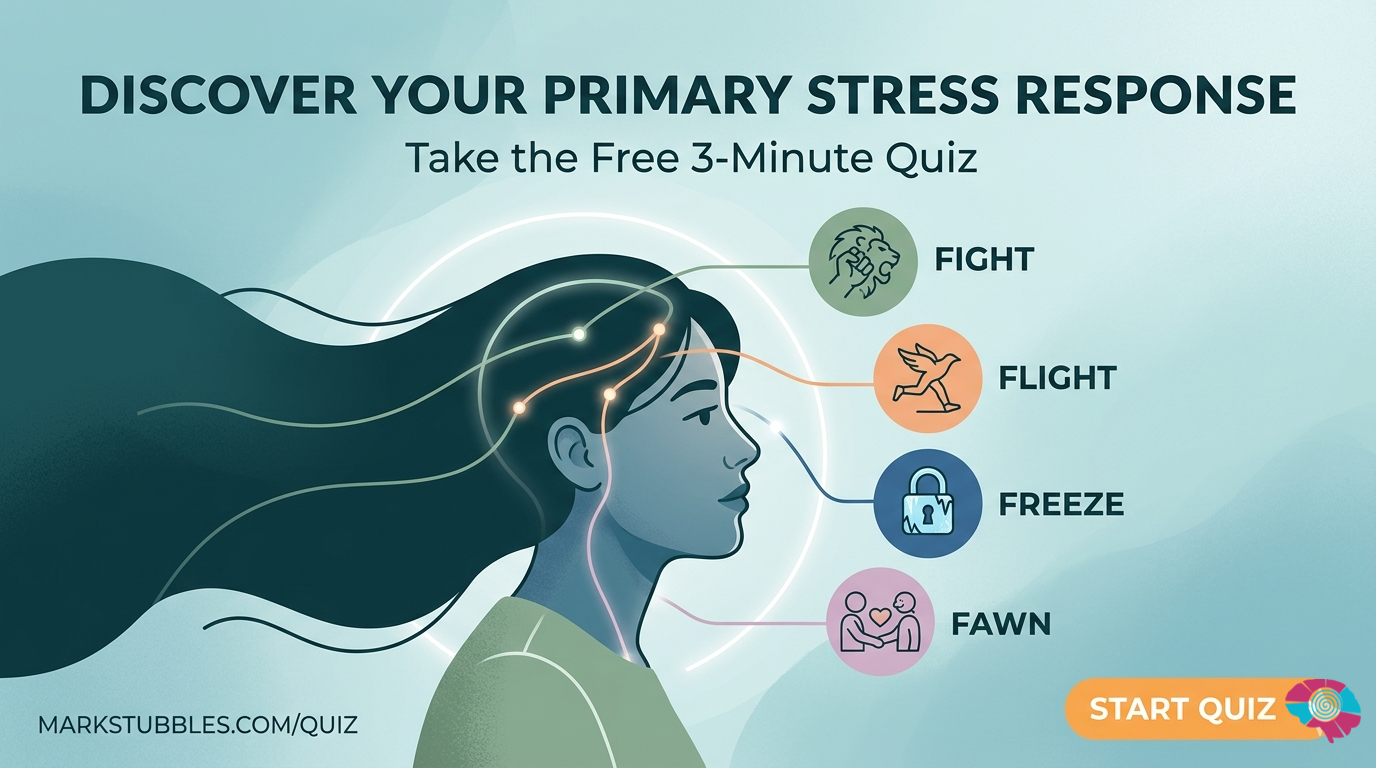
| Interactive Assessment: Map Your Nervous System |
| Understanding your own primary stress response is a powerful first step. The body’s survival strategies, fight, flight, freeze, and fawn, each leave a distinctive signature in how you feel, how you relate, and how you cope under pressure. Take the free Stress Response Quiz to identify your primary nervous system survival style and understand how your body responds to trauma. Knowing your pattern is the beginning of changing it. |
Navigating Complex States: Dissociation and BPD Traits
Dissociation: The Nervous System’s Emergency Brake
Dissociation is frequently misunderstood, even feared. In clinical reality, it is one of the most elegant and sophisticated protective mechanisms the human nervous system possesses. When the body faces a threat it can neither fight nor flee, when the terror is too great and the options have run out, the mind does something extraordinary: it removes the conscious self from the experience. It creates distance between the person and what is happening to them.
This can manifest as feeling emotionally numb during stressful situations, as if watching your own life from the outside. It can involve time gaps, a sense of unreality, or a feeling of fragmentation between different “parts” of the self. In its more structured forms, it underpins dissociative disorders. But in its everyday expressions, it is present in a great many people living with complex trauma.
Dr. David Spiegel, Professor of Psychiatry at Stanford University and one of the world’s leading researchers on hypnosis and dissociation, has extensively documented how trauma survivors naturally utilise dissociative capacity as a defence mechanism. What his research illuminates is something clinically significant: the same neurological capacity for deep absorption that underlies dissociation is precisely the capacity that is engaged during hypnotherapy. Hypnotherapy does not impose an alien state on the mind. It works with a capacity the nervous system already possesses, redirecting it from fragmentation toward integration.
Within a safe, well-structured therapeutic relationship, hypnotherapy can gently facilitate access to dissociated material, providing a context in which fragmented memories, emotions, and self-beliefs can be acknowledged, reframed, and progressively integrated, without forcing the client to re-experience raw trauma in an uncontained way.
BPD Traits as Survival Adaptations
A question that arises frequently in the context of hypnotherapy and complex trauma is whether it can be helpful for those experiencing traits associated with Borderline Personality Disorder (BPD). The answer is nuanced, and the framing matters enormously.
BPD is perhaps best understood not as a personality defect but as a set of intense, structural survival adaptations to severe attachment trauma and profound early emotional dysregulation. When a child grows up without consistent, attuned emotional mirroring, the developing nervous system struggles to build a stable sense of self, reliable emotional regulation capacity, or secure relational templates. The features of BPD, including emotional intensity, identity instability, and turbulent relationships, are the predictable outcomes of a nervous system that never learned it was safe enough to settle.
Subconscious retraining through hypnotherapy offers something genuinely useful here: it can access and begin to soften the core beliefs and survival programmes operating beneath conscious awareness, the beliefs that say “I am fundamentally unlovable” or “People always leave” or “I am dangerous to myself.” These are not rational conclusions. They are deeply encoded survival learnings, and the subconscious is the territory where they live. Hypnotherapy, applied carefully and within an appropriate clinical framework, can support stabilisation and provide a gentler pathway to the kind of inner security that traditional talking therapies sometimes struggle to reach.
The empirical evidence supports this direction. A comprehensive review by Hammond (2010) found that hypnotherapy effectively reduces the severity of intrusive trauma symptoms, supporting its use as a meaningful component within broader trauma treatment. This is not an alternative to clinical care. It is a powerful adjunct to it.
How Subconscious Healing Works Safely Online
There is still a great deal of cultural mythology around hypnotherapy, much of it shaped by stage hypnosis, film, and television. Clinical hypnotherapy for trauma is something entirely different. It is a collaborative, consent-driven process in which the practitioner guides the client into a state of relaxed, focused attention (a state most people have experienced naturally when absorbed in a book or a daydream) and uses that state to facilitate gentle, purposeful therapeutic work at the level of the subconscious mind.
You remain aware throughout. You cannot be made to say or do anything against your will. The hypnotic state is not unconsciousness. It is a heightened state of inner focus in which the critical, analytical part of the mind relaxes its grip, allowing the therapeutic suggestions, reframes, and resource-building to settle more deeply and durably than they might in an ordinary waking state.
For trauma specifically, the most critical distinction is between stabilisation work and trauma processing. Trauma processing (revisiting and reintegrating traumatic memory) is only appropriate when a client has sufficient internal resources and nervous system capacity to hold it. Skilled trauma-informed practitioners do not rush to the material. They build the container first.
The ISSTD Phase-Oriented Model: Safety First, Always
The International Society for the Study of Trauma and Dissociation (ISSTD) provides the gold-standard clinical framework for working with complex trauma and dissociation: a phase-oriented treatment model that insists on sequenced, paced work. Phase 1, which can take weeks, months, or longer depending on the individual, is dedicated entirely to safety, stabilisation, and psychoeducation. This means building the client’s window of tolerance (their capacity to experience difficult internal states without becoming overwhelmed), developing grounding and self-regulation skills, and establishing a trusting therapeutic alliance before any deeper processing is attempted. Trauma-informed hypnotherapy aligns fully with this model.
In practice, this looks like a series of sessions focused on nervous system regulation
first. Clients learn to orient to the present moment, to access an internal sense of safety, and to develop a richer toolkit of self-soothing resources. Only from that stable foundation does deeper subconscious work begin.
The Unique Advantages of Working Online
Online hypnotherapy offers something that many clients with complex trauma find unexpectedly significant: environmental control. Attending sessions from your own home means you are in a space you know, surrounded by your own things, with a sense of physical autonomy that a clinical setting may not provide.
For clients who have experienced a history of having their safety, boundaries, or sense of control violated, this matters. The body is more willing to relax into deeper states of receptivity when it feels genuinely safe in its environment. Many clients report that working online allows them to go deeper, more comfortably, than they expected. Grounding at the end of a session is also simpler when you are already home: there is no journey back, no transition through public space while still tender and open from the work.
Practically, online delivery also removes barriers of geography, mobility, and the social anxiety that a clinic environment can trigger for some clients, making consistent, regular sessions far more accessible.
From Survival to Sovereignty
Nervous systems are not fixed. The science of neuroplasticity has made clear what many experienced clinicians had already observed: the brain retains a remarkable capacity to reorganise, to form new neural pathways, and to update its most fundamental operating assumptions, even in adulthood, even after decades of trauma-driven patterning. This is not wishful thinking. It is the biological foundation of hope.
The path from chronic survival mode to a genuine sense of sovereignty over your inner life is not a straight line. It is iterative, sometimes non-linear, and deeply personal. But it is a real path. Clients who begin with barely a sliver of felt safety gradually expand that window. The nervous system learns, slowly and with repetition, that it can rest. That threat is not perpetual. That they are allowed to take up space.
It is worth noting that unresolved nervous system dysregulation rarely stays confined to one area of life. Chronic hypervigilance and unprocessed trauma can contribute to a range of patterns that may feel unrelated at first glance, including a fear of open spaces and the outside world, which you can explore further through the work on
Unresolved nervous system dysregulation rarely stays confined to one area of life. Chronic hypervigilance and unprocessed trauma can contribute to a range of patterns that may feel unrelated at first glance. It can manifest as a fear of open spaces and the world outside, which you can explore further on the hypnotherapy for agoraphobia page. It can also drive the pull toward addictive and self-soothing behaviours as the nervous system seeks relief from its own overactivation, something explored in depth in the work on hypnotherapy for addiction and the root causes of unwanted behaviours. These are not separate problems. They are different expressions of the same underlying dysregulation, and healing one often softens the others.
If you are living with the weight of complex trauma, CPTSD, or the quiet exhaustion of chronic nervous system dysregulation, know this: the fact that you are here, reading this, and considering a path toward healing already speaks to something resilient in you. That resilience is the ground from which genuine, lasting change grows.
Clinical References
Hammond, D. C. (2010). Hypnosis in the treatment of anxiety and stress-related disorders. Expert Review of Neurotherapeutics, 10(2), 263-273.
World Health Organization. (2018). International Classification of Diseases, 11th Revision (ICD-11). Complex Post-Traumatic Stress Disorder (6B41).
Spiegel, D. (2010). Hypnosis and the treatment of dissociative identity disorder. Psychiatric Annals, 40(12), 590-595.
International Society for the Study of Trauma and Dissociation. (2011). Guidelines for treating dissociative identity disorder in adults (3rd revision). Journal of Trauma and Dissociation, 12(2), 115-187.





Leave a Reply