

Have you ever ended a relationship only to find yourself in an eerily similar one a few months later? Have you caught yourself tolerating treatment you swore you never would, staying silent when you needed to speak up, or choosing partners who somehow always manage to leave you feeling not quite enough? This is not bad luck or a character flaw.
Long before you had the language for it, your nervous system was being shaped. Every moment of comfort, every experience of abandonment, every time your emotional needs were met or dismissed, every instance of warmth or criticism: all of it was being recorded. Not in a journal or a memory you can consciously access, but deep in the unconscious, where it became your working model of what love looks and feels like, what you deserve, and what is safe.
This is what we mean by the inner child. Not a literal smaller version of yourself sitting somewhere inside your chest, but the unconscious emotional record of your formative years. It is the part of you that still operates from the rules you had to create as a child in order to survive your particular family environment. And because those rules live below conscious awareness, no amount of intellectually knowing better tends to change them for long.
The science backs this up. A large, decades-long study published in the Journal of Personality and Social Psychology (Dugan et al., 2024) found that early dynamics with a mother figure predicted attachment styles across all primary adult relationships, including friendships and romantic partnerships. “People who felt closer to their mothers and had less conflict with their mothers in childhood tended to feel more secure in all of their relationships in adulthood,” the lead author noted, describing it as evidence of the enduring impact of that first person who is supposed to be there for you.
This is precisely why I had to seek healing childhood wounds deep work. After years of struggling with anxiety, CPTSD, and relationship patterns I could clearly see but seemingly not escape, I discovered that talking about my past was not enough. The wounds were not stored in my logical mind. They were stored deeper than that, and they needed to be reached at that deeper level. This guide is the most complete resource I have ever put together on how that process works: what created your relational patterns, how those patterns show up in your adult life, and what inner child healing through hypnotherapy actually does to change them.
The Root Wounds of Childhood
Before we can talk about patterns, we need to talk about their origin. Every template you carry into adult relationships was written in your earliest years, primarily through your relationship with your parents or primary caregivers.
Unpacking the Mother Wound
The mother wound is not about having a “bad mother.” Most of our parents did their best with what they had, often carrying unhealed wounds of their own. The mother wound is what develops when the primary nurturing relationship in our early life could not consistently provide what we needed: emotional attunement, unconditional acceptance, and a sense that we were inherently worthy of love and care.
When these needs go unmet (even partially, even inconsistently), the child internalises a core belief: I am not enough. Love must be earned. I have to perform or comply to be accepted. In adult life, the mother wound tends to manifest as chronic self-criticism, difficulty regulating emotions, a deep sense of unworthiness, compulsive reassurance seeking from partners, and sabotaging relationships when things are going well, because closeness without conditions feels unfamiliar and unsafe.
Unpacking the Father Wound
The father wound typically centres on issues of safety, identity, boundaries, and our sense of permission to take up space in the world. Where the mother relationship often shapes our internal world (how we feel about ourselves), the father relationship tends to shape our external one (how safe we feel asserting ourselves, setting limits, and trusting our own judgment).
When the father figure was absent, emotionally unavailable, critical, or unpredictable, children often grow into adults who struggle to set and maintain boundaries, carry a persistent low-level anxiety about the world, seek validation from authority figures, feel either invisible or “too much,” and attract emotionally unavailable partners because unavailability feels familiar.
How Early Trauma Shapes Adult Relational Patterns
Here is the dynamic that catches so many people off guard: we do not seek out partners who are like our healthiest experiences of love. We seek out partners who recreate the emotional feeling tone of our earliest attachments, because that feeling tone is what our nervous system has categorised as “normal.” If love in childhood felt anxious, unpredictable, or conditional, then a calm, consistent, available partner may feel oddly flat, even boring. The partners who make our nervous system light up with intensity are often the ones recreating a familiar wound.
British psychiatrist John Bowlby argued that these early relational experiences create internal working models that shape intimacy, trust, and commitment throughout life. Longitudinal research has confirmed that self-reported attachment style in adulthood is predictable from caregiver behaviour during infancy and early childhood. This is what psychologists call reenactment, and it will continue until the original wound is addressed at the level where it lives: the unconscious mind.
The Trauma Memories Bridge – Healing Without Narrative Recall
One of the most common reasons individuals hesitate to seek help for relational wounds is the belief that they cannot heal because they lack clear, narrative memories of their childhood. It is vital to understand that relational trauma and early abandonment wounds do not require a historical timeline of events to be resolved. Because your early emotional and physiological experiences were recorded before the age of reason, they are stored as unconscious, autonomic conditioning rather than conscious, verbal narratives.
In adulthood, these early imprints are actually experienced as real-time physical responses and relational triggers. When a partner’s slight shift in mood triggers a physical wave of panic or an automatic fawn response, your body is displaying the memory. In hypnotherapy, we do not need to reconstruct a historical timeline of events; we work directly with this physiological felt sense. If you would like to explore the neurobiological mechanics of how these experiences are physically wired into the brain, you can read my guide on how the brain stores trauma.
Codependency and People-Pleasing as Survival Responses
When a child cannot change their environment, they change themselves. This is an intelligent and adaptive response of the human nervous system. If expressing needs leads to conflict, the child learns to suppress them. If keeping the peace means absorbing a parent’s moods, the child learns to monitor and manage the emotions of others. A 2025 systematic review using the PRISMA framework confirmed that adults with unresolved childhood trauma frequently exhibit low self-esteem, anxiety, depression, and significant relational difficulties, while therapeutic approaches that emphasise self-awareness, emotional regulation, and inner child healing demonstrate positive recovery outcomes.
Redefining Codependency as an Unconscious Programme
Codependency is not simply “being too nice.” It is an unconscious relational programme built on the belief that your worth depends on your usefulness to others, and that meeting your own needs is unsafe, selfish, or something you are not entitled to do. The codependent person locates their sense of self in the approval, mood, and needs of others, constantly asking: Are they okay? Did I do something wrong? Meanwhile, their own needs are largely inaccessible or experienced with intense guilt.
This unconscious programme is relentlessly policed from within by the inner critic. In my work, I recognise that the inner critic is not your true voice or identity, but an introject (a foreign program) swallowed whole from critical caregivers during childhood. The inner critic acts as the active internal enforcer of codependent behaviour, triggering physical anxiety and deep-seated guilt the moment you attempt to say no or assert a boundary. True recovery requires shrinking the inner critic and softening the harsh, critical internal voice to dismantle this internal enforcer at its source, which you can learn about on my primary service page.
The Fawn Response and the Discomfort of Being Cared For
When your stress response assessment reflects a fawn pattern, it indicates a survival strategy where you reflexively prioritise others’ needs and walk on eggshells to manage the emotional atmosphere. The fawn response is the nervous system’s way of managing perceived danger through appeasement: if I make myself agreeable and unthreatening, the threat will pass. In adulthood, this plays out as an automatic override of your own needs in favour of others.
A highly counterintuitive phenomenon that many survivors find difficult to talk about is the deep discomfort, anxiety, or suspicion that arises when someone is genuinely kind, loving, or generous toward you. If someone pays you a sincere compliment, you dismiss it. If a partner is consistently warm and attentive, you find yourself waiting for the catch. This is not ingratitude; it is a nervous system response to an unfamiliar baseline. Your unconscious has catalogued a volatile or conditional environment as normal, so unconditional warmth registers as unfamiliar and therefore unsafe. Healing this pattern requires updating the baseline so your nervous system can experience safety as normal rather than suspicious.
Why Traditional Talk Therapy Struggles to Reach Unconscious Conditioning
Many individuals spend months or years in traditional talk therapy, analyzing their past and discussing their family history. While understanding your childhood is valuable, this top-down rational approach rarely resolves daily anxiety, physical tension, or relational panic. This occurs because understanding a problem and resolving it are two completely different neurological events. Your conscious, logical mind only operates about five to ten percent of your total behaviour. The remaining ninety to ninety-five percent is managed below the surface by your unconscious mind and the autonomic nervous system.
Highlighting the physical logic gap is essential here. Childhood stress and psychological abuse physically alter brain development. Landmark neuroimaging research conducted by Dr. Martin Teicher at Harvard Medical School demonstrates that early childhood stress is associated with reduced volume in the prefrontal cortex and left hippocampus, alongside an overactive, hyper-responsive amygdala. Because this threat-detection architecture is physically sculpted in childhood, triggers bypass logical cognitive pathways entirely. Trying to negotiate with a physical panic loop using conscious logic is like writing a polite letter to an engine, explaining that it should stop making a knocking sound. To break the cycle, you need a bottom-up approach that communicates directly with the unconscious mind.
Reparenting and Reprogramming Through Hypnotherapy
Reparenting is the process of consciously stepping into the role of the loving, attuned caretaker that your inner child needed but did not consistently have. It means learning to provide yourself, at an unconscious level, with the safety, validation, and comfort that were unavailable in your early life. In hypnotherapy, this is facilitated in a state of deep relaxation, where the critical analytical mind quietens and the unconscious becomes accessible, allowing you to communicate directly with younger versions of yourself.
The hypnotic state allows us to work at the level of the unconscious to examine, challenge, and rewrite deeply held core beliefs (such as ‘I am unlovable’ or ‘I am only safe when I am useful’). This bottom-up emotional update is supported by compelling clinical evidence. A 2022 study by Edalat et al. evaluated a reparenting-based intervention using the self-attachment technique, demonstrating statistically significant improvements in chronic depression and anxiety with large effect sizes. Furthermore, a meta-analysis of clinical studies in the Journal of Traumatic Stress (O’Toole et al., 2016) found that hypnotherapy had a strong positive effect on trauma symptoms, and a 2021 pilot study on IFS therapy found that 92% of participants no longer met the diagnostic criteria for PTSD after treatment.
By healing these core relational wounds, you do not just transform your own life; you break generational patterns that would otherwise be passed down to your children. When you heal your inner child, you create the space to respond with compassion rather than repeating patterns from your own upbringing. You model self-compassion, regulate your autonomic nervous system, and establish durable, unconscious safety that allows your entire family system to thrive.
Comparison of Relational Recovery Methods
| Recovery Aspect | Traditional Logical Methods | Unconscious Relational Approach |
| Primary Mind State | Conscious analytical mind which governs only a small fraction of daily behaviour | Receptive theta wave states where early relational maps can be updated safely |
| Processing Mechanism | Intellectual analysis and cognitive worksheets that do not calm physical reflexes | Memory reconsolidation to strip the emotional charge from early conditioning |
| Relational Recovery | White-knuckling through anxiety to force boundaries using conscious willpower | Reparenting the younger self to establish a physiological baseline of safety |
Healing this pattern requires more than recognising it intellectually. It requires working with the subconscious directly to update the baseline: to allow the nervous system to experience safety and warmth as genuinely normal, not as something suspicious or temporary.
Identify Your Pattern
Understanding your nervous system’s default survival mode is often the first step to changing it.
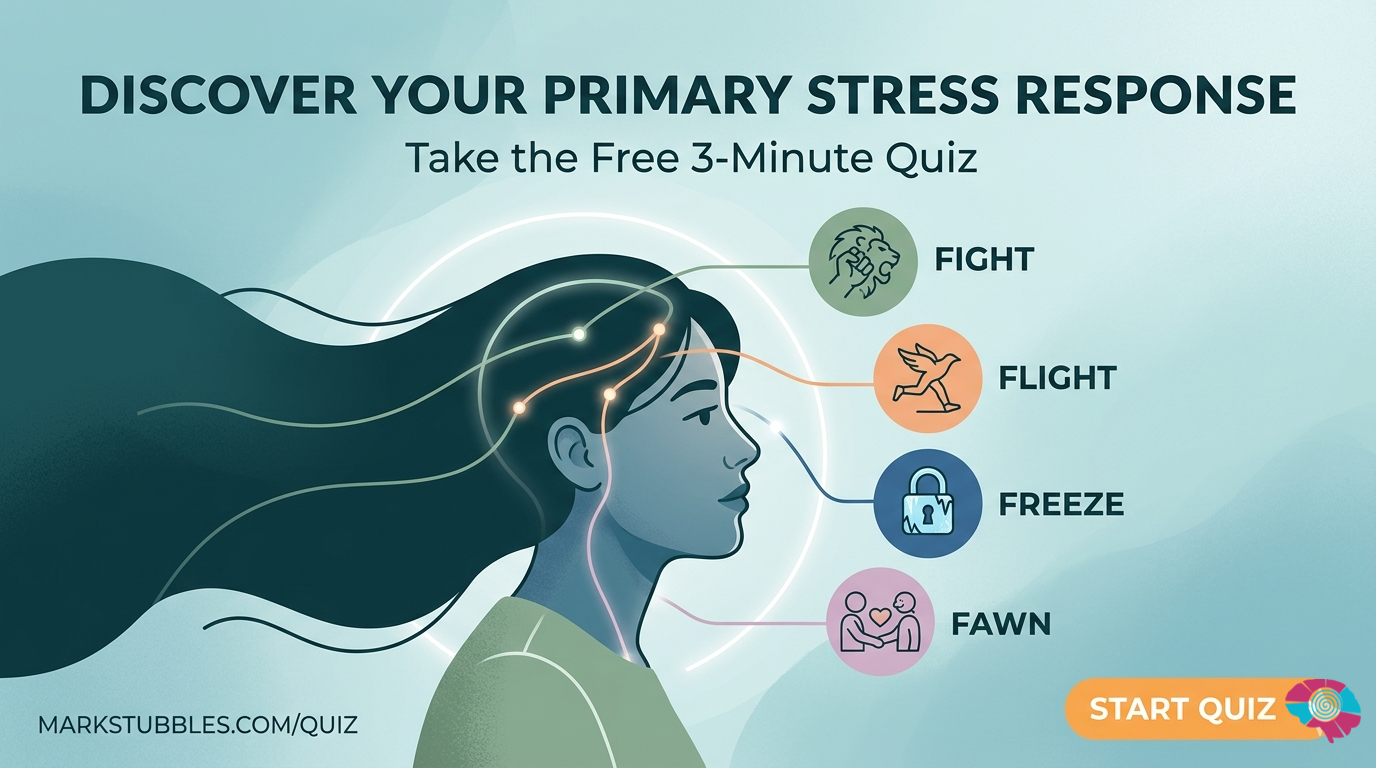
Take the Stress Response Quiz to discover whether your nervous system relies on Fight, Flight, Freeze, or Fawn when relationships feel unsafe. Knowing your dominant pattern gives you a precise starting point for the inner child work that follows.
FAQs: Common Questions About Inner Child Hypnosis
Can this work really be done online? Is it as effective as in-person?
This is one of the most common questions I receive, and the answer is a firm yes. Online hypnotherapy for inner child healing can be just as effective as in-person work, and for many clients it is actually preferable. Being in your own environment, whether your home, your bedroom, or anywhere you feel safe and comfortable, can help your nervous system settle more quickly. The familiar surroundings reduce background anxiety, which means you often access deeper states of relaxation more readily than you might in a clinical setting.
The therapeutic relationship and the quality of the approach matter far more than the medium. Everything that happens in my in-person sessions happens in my online sessions: the guided inductions, the inner child dialogues, the somatic processing, the reparenting work. The only difference is the screen.
How long does it take to notice a shift?
This varies from person to person, because the depth and complexity of your particular patterns plays a role, as does how long those patterns have been in place. That said, most of my clients begin to notice meaningful shifts within three sessions. These shifts are not always dramatic revelations: often they appear as small but significant changes in automatic behaviour. You notice you held a boundary without rehearsing it. You received a compliment and did not immediately dismiss it. You caught yourself defaulting to the fawn response and paused.
These early shifts matter enormously, because they are evidence that the subconscious is updating. The deeper work of full integration typically unfolds over a series of sessions, with each one building on the last.
What if I cannot remember my childhood?
This is one of the most important questions to address, because it stops many people from starting. The belief that you need clear, detailed childhood memories in order to do inner child work is a misconception.
The subconscious stores emotional and somatic experiences differently from the conscious, narrative memory. You may not be able to tell me what happened when you were four years old, but your body and your nervous system remember the emotional residue of that time. Hypnotherapy works with this residue directly. We do not need to reconstruct a timeline of events. We work with the felt sense of what it was like to be you, at younger ages, in your particular family environment.
In many cases, clients are surprised by what emerges in the relaxed state of hypnosis, not as fabricated memories, but as emotional impressions and insights that feel deeply true. And even in cases where nothing “comes up” visually or narratively, the process still works, because we are communicating with the subconscious through imagery, feeling, and metaphor rather than through logical recall.To learn more see my post, how the brain stores trauma
Is hypnosis safe if I have experienced trauma?
Yes, when conducted by a practitioner trained in trauma-informed care. My approach is specifically designed to work with the nervous system rather than against it. Unlike some traditional therapies that require you to revisit and verbalise painful memories in detail, hypnotherapy for inner child healing focuses on your current relationship with those younger parts of yourself. You remain grounded throughout. We move at a pace that your nervous system can tolerate, releasing the emotional charge of the past without requiring you to relive it. See my hypnotherapy for PTSD post
Take Control of Your Relational Future
Every relational pattern, boundary struggle, or protective fawn response you carry today was created by a very young person doing the best they could to survive their early environment. These strategies were intelligent adaptations then, but they do not have to dictate your life today. By resolving these core patterns in the unconscious, you can update your internal working model, release unearned guilt, and build relationships on a foundation of true emotional safety.
If you are ready to begin this deep work, the first step is to explore practical bottom-up tools. You can find a complete physiological and unconscious toolkit in my Unlearn Your Fear book.. When you are ready to work at the deepest level, I invite you to Book a free consultation call to discuss how one-to-one hypnotherapy can support you in reclaiming your power.





Leave a Reply