
You might tell yourself it is just nerves. A flicker of heat rising in your cheeks before a presentation, after a mistake, or when someone looks at you a beat too long. You might have spent years hoping people would not notice, changing your behaviour to avoid triggers, or feeling quietly ashamed of a reaction you cannot seem to control.
Most people, even many therapists, do not fully appreciate that blushing is not a personality flaw. It is not shyness dressed up in physiological clothing. In many cases, chronic, involuntary blushing is the body’s language for something it has never been given the chance to say out loud.
“The body keeps the score.” – Dr. Bessel van der Kolk, psychiatrist and trauma researcher. This phrase captures something clinically essential: the residue of overwhelming experience is held not just in the mind, but in the automatic, sub-cognitive responses of the body itself.
In this article, we will explore the neurobiology behind why trauma causes involuntary physical responses like chronic blushing, how a condition known as erythrophobia fits into the wider picture of somatic trauma, why traditional talk therapy often falls short, and how hypnotherapy offers a route to genuinely resetting the nervous system’s threat response.
The Science of the Somatic Survival Loop
The Amygdala as Your Brain’s Alarm System
At the centre of all threat-based responding sits a small, almond-shaped structure deep in the brain: the amygdala. Its job is elegantly simple: scan the environment for danger and trigger a response before the thinking brain has time to catch up.
In an acute crisis, this is a life-saving feature. When you pull your hand away from a hot stove before you have consciously registered pain, that is your amygdala at work. It is fast, automatic, and profoundly good at keeping you alive.
The problem arises when the amygdala has been recalibrated by trauma. After a prolonged period of stress, abuse, humiliation, or any experience that overwhelmed the nervous system’s capacity to cope, the amygdala can become chronically sensitised. It starts to read neutral, even safe situations as threats. It fires the alarm not because danger is present, but because the pattern resembles something that was once dangerous.
Think of it like a smoke detector that has been set too sensitively after a kitchen fire. Long after the fire is out, the smell of toast still sets it off. The alarm is real. The response is real. But the threat level has been misread.
The Autonomic Shift from Parasympathetic to Sympathetic
The autonomic nervous system operates in two primary modes. The parasympathetic branch governs rest, digestion, connection, and recovery (the rest and digest state). The sympathetic branch governs emergency responses: the surge of adrenaline and cortisol, the acceleration of heart rate, the diversion of blood to the muscles, and the heightened state of alertness we know as fight-or-flight.
In a healthy, regulated nervous system, these two branches work in balance, shifting fluidly between activation and recovery depending on what the environment demands.
In a trauma-conditioned nervous system, this balance is disrupted. The sympathetic branch becomes dominant, triggering the physiological hallmarks of threat response including dilation of superficial blood vessels even when the perceived threat is a social one, such as being observed, judged, or put on the spot.
Blushing, at its most fundamental level, is a sympathetic nervous system event. It is caused by the rapid vasodilation of blood vessels in the face, neck, and chest in response to perceived social evaluation. In people with a trauma-sensitised nervous system, this response is not just occasional. It is a hair trigger, set to fire at the slightest social signal of scrutiny.
The Somatic Survival Loop
One of the most important concepts in somatic trauma work is the somatic survival loop (a self-perpetuating cycle in which):
- A social or emotional trigger activates the sympathetic nervous system
- The body responds with physical symptoms (blushing, sweating, shaking, heart racing)
- The person notices the physical response and becomes anxious about it
- That anxiety itself becomes a new trigger, intensifying the sympathetic activation
- The cycle repeats, reinforcing the neural pathway with every iteration
Over time, this loop becomes encoded in the body as a default pattern. The nervous system does not distinguish between being in danger and the fear of being seen to blush; both fire the same cascade of physiological responses. The body has learned to treat social vulnerability as a survival threat.
Erythrophobia as a Somatic Trauma Response
Erythrophobia (from the Greek erythros meaning red, and phobos meaning fear) is defined as a persistent, intense fear of blushing. It is recognised within the broader category of social anxiety disorder, but it warrants specific attention because it involves a particularly difficult double-bind: the fear of blushing is itself one of the most reliable triggers for blushing.
But describing erythrophobia simply as shyness or social anxiety undersells its complexity and its roots. For many sufferers, erythrophobia is better understood as a specific somatic manifestation of hypervigilance: the body’s learned state of chronic readiness for threat.
Erythrophobia is not vanity. It is not oversensitivity. For many sufferers, it is the surface expression of a nervous system that learned, in conditions of threat or shame, that being visible is dangerous.
What the Clinical Research Tells Us
Drummond (1997, 2003) demonstrated that people with a fear of blushing do not just blush more frequently: their nervous systems take measurably longer to return to physiological baseline after a blushing episode. This prolonged physiological arousal means the nervous system stays heated for longer, which is consistent with a reduced capacity for the parasympathetic rest and recover response to reassert itself.
A meta-analysis by Nikolić and colleagues (2015) provided confirmation that blushing is a reliable physiological marker of social threat detection. The research highlighted that blushing functions as an involuntary signal over which the individual has little conscious control, pointing toward the need for interventions that address the threat-detection system at a biological level rather than simply reframing thoughts.
Furthermore, Laederach-Hofmann and colleagues (2002) demonstrated that patients with erythrophobia exhibit abnormal autonomic regulation under conditions of mental stress. The autonomic nervous system in these individuals responds to emotional stressors in ways that are dysregulated, aligning with the broader literature on autonomic dysregulation in trauma.
Why Traditional Talk Therapy Often Falls Short
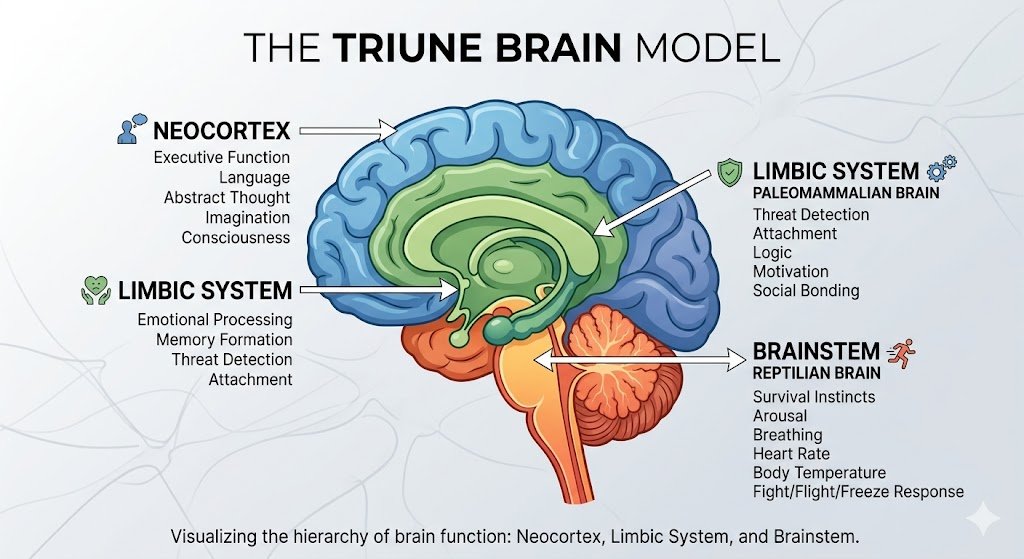
The Triune Brain Architecture
To understand why cognitive and verbal therapies (such as Cognitive Behavioural Therapy) often produce limited results for erythrophobia and somatic trauma responses, we need to understand a fundamental architectural feature of the human brain.
The brain can be loosely understood in terms of three functional layers:
- The Neocortex (prefrontal cortex): responsible for rational thought, language, planning, and conscious reflection (the new brain)
- The Limbic System: the emotional brain, responsible for memory, attachment, and emotional processing (including the amygdala)
- The Brainstem and Cerebellum: responsible for automatic, survival-oriented functions (the old brain)
Talk therapy works primarily in the realm of the prefrontal cortex, engaging language, narrative, and conscious reflection. For conditions that are primarily cortical, this is exactly the right tool. But blushing is not a cortical event. It is generated by the brainstem and limbic system, structures that predate language and are not directly accessible through conversation. You cannot talk your amygdala out of its threat response any more than you can consciously slow your heart rate by reasoning with it.
“Trauma is not stored in the narrative memory. It is stored in the body, in sensation, in the reflexes that fire before thought can intervene. Healing it requires working below the level of language.” – Mark Stubbles, Hypnotherapist
Many erythrophobia sufferers have spent years in therapy, understand intellectually that blushing is harmless and that others probably do not notice, yet they still blush. This is because when the survival system is activated, the prefrontal cortex goes partially offline (a process called cortical inhibition). The very brain regions that talk therapy targets become less available precisely when they are most needed. Hypnotherapy bridges this gap by communicating directly with the unconscious.
The Role of Hypnotherapy
In a clinical context, hypnotherapy is a powerful method for inducing a profoundly relaxed, focused state of awareness. A state in which the critical, analytical filters of the prefrontal cortex are gently set aside, creating direct access to the limbic system and the autonomic nervous system. This is precisely the access that makes hypnotherapy uniquely suited to working with conditions like erythrophobia and somatic trauma responses.
Hypnotherapy works through several interconnected mechanisms:
- Nervous System Recalibration: Deep relaxation activates the parasympathetic nervous system. Repeating this in trance builds new associations, so social situations that have long been paired with sympathetic activation start pairing instead with safety, ease, and calm.
- Reprocessing the Root Cause: We safely access earlier experiences, often from childhood or adolescence, that initially calibrated the nervous system to treat social visibility as a threat. Re-evaluating these memories in a state of physical safety reduces their emotional charge.
- Installing New Physiological Responses: The nervous system does not fully distinguish between a vividly imagined experience and a real one. This mental rehearsal trains the brain to associate visibility with composure.
- Reducing the Anticipatory Anxiety Loop: By addressing the anticipatory fear directly at the unconscious level where it originates, the self-perpetuating cycle can be broken at its source. You can explore how these patterns operate in my article comparing CBT vs hypnotherapy for blushing.
Hypnotherapy does not suppress the blush through force of will. It addresses the underlying miscalibration of the nervous system. The alarm stops firing because the system learns that there is no fire.
For people dealing with blushing and social anxiety, online sessions work particularly well. Having to travel to a therapist’s office, sit in a waiting room, and interact with reception staff is often a gauntlet that primes the nervous system before the session has even begun. Working from your own home removes that barrier, allowing for a deeper state of relaxation. If you are ready to begin, you can review my specialized hypnotherapy to stop blushing sessions or explore my Beyond Blushing eBook for a practical introduction to these methods.
Complementary Tools for At-Home Practice
These self-regulation exercises function as physical stabilizers to manage your body’s physiology in the moment, complementing your deeper unconscious work:
- Emotional Freedom Technique (EFT): Tapping on specific meridian points, such as the edge of the hand or below the collarbone, gives the nervous system a competing sensory input, which interrupts the internal monitoring loop that feeds the blushing reflex.
- Extended Exhalation Breathing: Exhaling for longer than you inhale directly stimulates the vagus nerve, signaling the brain to shift from sympathetic fight-or-flight to parasympathetic recovery. Try a pattern of inhaling through the nose for four seconds and slowly exhaling for eight seconds.
These techniques manage the surface symptoms in the moment while hypnotherapy works on the underlying pattern that causes the sympathetic alarm to sound.
A Different Relationship with Your Body
If you have lived with chronic blushing, you may have come to see your body as the enemy, a source of embarrassment and betrayal. But your nervous system simply learned what it learned in conditions that were, at the time, genuinely overwhelming. The survival loop it built was an intelligent response to an environment that felt threatening. It is not a character flaw.
Because these responses are learned, they can be unlearned. The nervous system remains plastic and capable of building new pathways. By working meeting the nervous system where it lives, you can help your body understand that the threat is over, allowing you to return to a natural baseline of calm composure.
| Ready to work directly with your nervous system? Explore the Beyond Blushing E-book: a resource designed to help you understand and begin to resolve chronic blushing from the inside out. markstubbles.com/product/beyond-blushing-e-book Or Book a Call to explore one-to-one Hypnotherapy for Blushing sessions. |





Leave a Reply