Online Anxiety Hypnotherapy: Heal the Root of Trauma & C-PTSD
Award-Winning, Trauma Informed, Certified Hypnotherapist Online.
Overcoming Trauma, PTSD, and C-PTSD with Hypnotherapy
Are you ready to break free from chronic anxiety, emotional dysregulation, and persistent self-doubt? As an award-winning, trauma-informed, and certified hypnotherapist, I specialize in helping clients worldwide overcome the invisible blocks holding them back. If you are struggling with the heavy, persistent echoes of past experiences, please know that healing is entirely possible. By accessing the unconscious mind directly, we can safely recondition the automatic threat responses that logic cannot reach, allowing you to regain authentic control over your life and build a future of deep, lasting safety.
My mission is simple: to empower you to release the protective, survival-driven habits that no longer serve your growth. Having spent decades navigating my own complex nervous system challenges, I understand the profound impact of a personalized, trauma-informed approach. Hypnotherapy is more than a therapeutic modality: it is a gentle, bottom-up process of nervous system integration that helps you let go of hypervigilance and thrive.
Online Hypnosis for Anxiety
Overcome Anxiety With Hypnosis
In the UK it is estimated that 25% of the population suffers with anxiety or depression and 9% suffers with anxiety and depression. But anxiety is not a disease, a disorder or a mental illness. Book a call to find out how hypnotherapy can help you.
Inner Child Healing
Inner Child Healing Hypnosis
We could all benefit from inner child healing because we all pick up unwanted habits and behaviours in childhood. Inner child healing can help adults to quieten their inner critic, reduce anxiety and feel more secure in the world to achieve success.
Hypnosis For Blushing
Hypnosis To Stop Blushing
I had issues with anxiety, CPTSD, low confidence and self-esteem in the past and hypnosis has been effective in helping me with them all but blushing was probably my biggest success. Blushing used to be a huge issue for me and I was able to overcome it in just one self-hypnosis session.
A Client Who Suffered PTSD & Anxiety Recently Said
“I am so grateful for having hypnotherapy sessions from Mark – I was really suffering with anxiety to the point of having many panic attacks and felt frightened. I did my research and decided to have 6 sessions and I am so grateful I did. Mark is a lovely man so understanding which helped me open up and therefore treatment was successful. I now haven’t had a panic attack – slowed down and said yes to things I wouldn’t of normally done. I would definitely recommend to friends and family.”
My Personal Journey Through C-PTSD and Panic
For decades, my daily existence was defined by a silent, exhausting battle with complex post-traumatic stress disorder (C-PTSD) and intense social panic. I grew up in a volatile family system where my physical and emotional boundaries were constantly overridden. I internalized that chaos, developing a cruel, toxic inner voice that picked my performance apart in real time. My body was locked in constant survival-mode bracing: my jaw clenched at night, my palms sweat, and my face would turn beetroot red at the slightest sensation of public visibility. At school, my focus was poor, and I frequently dissociated, checking out of my body into a defensive dreamworld.
In adult life, this deep-seated anxiety continued to run my personal and professional decisions. I adopted narcissistic, controlling shields to keep people at a distance, and I entered a series of manipulative relationships, subconsciously recreating the familiar struggle of my youth. To protect myself from exposure, I weaponized my wit and corporate sales targets, using hyper-logic and over-preparation to control every conversation. While I appeared successful on paper, my internal system was in a state of high-functioning panic. When my first marriage dissolved, the resulting five-year family court battle in stuffy, hostile chambers pushed my nervous system to its absolute limit.
It was out of complete desperation, isolated and terrified, that I started listening to hypnotherapy recordings online, along with spiritual talks by people like Alan Watts. I realized that my conscious willpower could never stop an automatic reflex. My tiny, logical rider was powerless because my six-tonne subconscious elephant was spooked. By working directly with these deeper subconscious maps, I was able to safely update the protective scripts. I have worked through this painful struggle myself, and I have helped hundreds of others do the exact same. Healing is not about becoming a flawless, unshakeable machine: it is about self-acceptance, boundaries, and giving your nervous system permission to stand down.
Understanding the Impact of Trauma, PTSD, and C-PTSD
Traumatic experiences, including childhood neglect, narcissistic abuse, or sudden shocks, physically alter how your brain processes the world. Under normal conditions, your threat-detection system activates in response to immediate physical danger. However, when you are subjected to prolonged, inescapable stress, your amygdala grows and becomes hyper-responsive, while the logical prefrontal cortex decreases in relative activity. This neurobiological shift ensures that your nervous system remains stuck in a sustained state of hypervigilance, constantly scanning for danger even when you are completely safe.
This persistent vigilance keeps the sympathetic nervous system continuously active, flooding your body with adrenaline and cortisol. Over time, your attention filter (the Reticular Activating System, or RAS) locks onto threat detection as its default setting. It reads neutral social cues as immediate dangers, triggering involuntary physical responses like shallow breathing, tight shoulders, and a racing heart. This is the physiological reality of PTSD and C-PTSD. Hypnotherapy works to downregulate this hyper-active alarm directly at its source, using relaxed, focused states of attention to signal physical safety directly to the unconscious motor networks.
Core Pillars of Healing
Because unresolved trauma affects multiple aspects of your physical and emotional life, my work focuses on four highly specialized core pillars of recovery. Each pillar represents a critical pathway to help you reclaim your personal freedom and unconscious security:
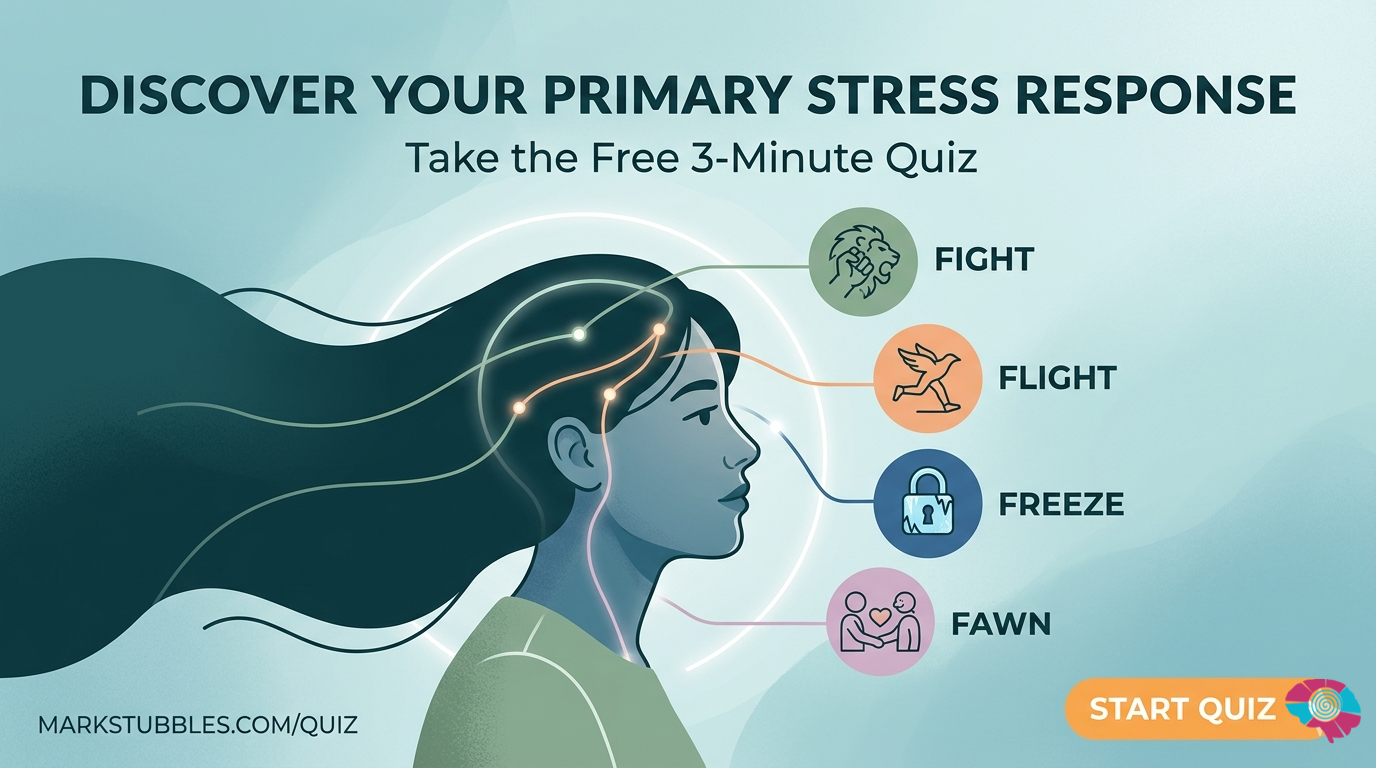
- 1. Anxiety & Hypervigilance: When your system is stuck in fight-or-flight, your brain is forced to spend excessive, unnatural amounts of time running high-speed survival dream simulations. This nocturnal hyperarousal overheats your dream machine, sacrificing deep, physically restorative sleep and leaving you completely depleted in the morning. Learn how to break this loop on my Waking Up Exhausted page.
- 2. Inner Child Healing & Codependency: Unresolved childhood conditioning forces us to take on rigid family roles like the People Pleaser, Perfectionist, or Black Sheep. We establish unconscious contracts, putting others’ needs first to prevent abandonment. Through active reparenting under hypnosis, we provide the younger self with safety, validation, and protection. Read my complete guide on my Inner Child Healing page.
- 3. Chronic Blushing & Social Panic: Erythrophobia is the fear of blushing itself, which quickly spirals into a self-reinforcing Cycle of Fear. Blushing evolved as an ancient physical billboard of submission designed to prevent tribal exile. Through hypnotherapy, we bypass your analytical barriers to calm this autonomic reflex, letting you feel composed in any meeting. Explore my dedicated guide on my Hypnotherapy to Stop Blushing page.
- 4. Emotional Abuse & Toxic Relationship Loops: Growing up in an unpredictable or critical home, or surviving an adult narcissistic relationship, teaches your nervous system that walking on eggshells is a biological necessity. This prolonged emotional chaos keeps your threat-detection system on high alert, leaving you second-guessing your own reality. Through targeted hypnotherapy, we clear the toxic shame, break the trauma bonds, and help you reclaim your authentic self.
Why Talk Therapy Alone Struggles to Resolve Trauma and PTSD
Many people spend months or even years in traditional talk therapy, analyzing their past, documenting their cognitive thoughts, and discussing their family history. While understanding your childhood is highly valuable, this top-down rational approach rarely resolves chronic panic or physical muscle bracing. This occurs because understanding a problem and resolving it are two completely different neurological events.
Your conscious, logical mind only operates about five to ten percent of your total behavior. The remaining ninety to ninety-five percent is managed below the surface by your unconscious mind and the autonomic nervous system. When a physical trigger fires, it bypasses conscious reasoning entirely. You cannot logically debate with a subcortical motor spasm or an autonomic reflex. To break the cycle of hypervigilance, you need a bottom-up approach that communicates directly with the unconscious mind during natural states of focused relaxation, allowing your threat-detection centers to register genuine, physical safety.
Who is Mark Stubbles, Trauma-Informed Hypnotherapist?
I am an award-winning, trauma-informed hypnotherapist specializing in helping people heal from the aftereffects of C-PTSD, PTSD, and chronic anxiety. My extensive training includes advanced hypnotherapy, psychotherapy, and certifications as a Master Practitioner of NLP, Cognitive Behavioral Therapy (CBT), Mindfulness, and Emotional Freedom Technique (EFT) tapping. I was honored to receive a professional achievement award and be announced as the best hypnotherapist in Windsor, Berkshire.
This diverse, evidence-informed skillset allows me to offer a supportive, highly personalized approach tailored to your unique system. Together, we work to address the root causes of your symptoms, reframe traumatic memories to reduce their emotional impact, develop gentle physical coping tools, and cultivate a secure internal foundation of self-acceptance.
Real Transformations from Clients Who Have Overcome Trauma
“First time with hypnotherapy. Mark had a warm and compassionate approach that created a sense of safety and acceptance. I would highly recommend. Very professional and ethical practitioner.”
– Sarah, Educational Consultant
“I have noticed a difference in just three sessions. I know I have work to do myself too, but I have felt more confident and less anxious. I hope to notice more changes in time.”
– David, Anxiety Client
Ready to Overcome Anxiety or Trauma? Book A Call
Frequently Asked Questions About Trauma, PTSD, and C-PTSD Recovery
How many sessions will I need to see results?
It varies from client to client, and we will discuss this in detail during your free consultation. For most people, hypnotherapy produces noticeable shifts within the first session. The majority of my clients reach their primary goals within three sessions. However, some carry deeper developmental concerns, complex childhood wounds, or long-standing patterns of anxiety. For those clients, additional sessions create more thorough and durable change.
Is online hypnotherapy as effective as in-person?
Yes, online hypnotherapy is fully as effective as in-person treatment. Many clients find online sessions even more comfortable and secure, as they participate from the privacy and comfort of their own home in a familiar, relaxing environment. Clinical research shows that virtual hypnotherapy sessions produce comparable, durable results to in-person therapy across all major anxiety and trauma treatments.
Will I lose control or be "put under" during the session?
Absolutely not. Hypnosis is not mind control, and it is completely separate from stage entertainment. You are never asleep or unconscious. Instead, hypnotherapy is a state of deeply relaxed, focused attention. You remain in complete, wakeful control throughout the entire session. You can speak, move, open your eyes, or pause the session at any moment, and your unconscious mind will immediately reject any suggestion that conflicts with your core values or personal beliefs.
Hypnosis for Trauma
Is hypnotherapy safe for someone with PTSD or C-PTSD?
Yes, hypnotherapy is highly safe and effective for PTSD and C-PTSD when conducted by a trained, trauma-informed professional. Unlike traditional talk therapies that can accidentally re-traumatize you by forcing you to deeply relive painful memories or recount traumatic details, hypnotherapy focuses on establishing internal safety. We use bottom-up, physical safety signals to gently calm your overactive threat-detection system, ensuring you remain grounded and supported throughout.
How does narcissistic abuse lead to chronic anxiety?
Narcissistic abuse creates a prolonged state of unpredictability and emotional chaos that keeps your nervous system on constant high alert. Common patterns include hypervigilance (monitoring the abuser’s mood to protect yourself), walking on eggshells (uncertainty and fear of making mistakes), gaslighting (eroding your self-trust), and a profound loss of interpersonal safety. Over time, your system gets stuck in fight-or-flight, maintaining physical tension in the musculature. Hypnotherapy helps to update these old survival maps, restore your unconscious baseline of safety, and reduce the chronic anxiety that stems from these relationship loops.
What is the main difference between general anxiety and PTSD?
While both involve intense feelings of threat, their origins and physical expressions differ. General anxiety typically involves persistent, future-focused worry about everyday events, often manifesting as a constant background hum of unease. PTSD, by contrast, is an active intrusion of past traumatic events into the present, characterized by flashbacks, nightmares, or intense reactions to reminders of the trauma. In both cases, your autonomic nervous system is stuck in survival mode, and hypnotherapy works directly with the unconscious to repattern the alarm response.
Do you use regression techniques?
Rarely. Even when working with inner child integration, I use hypnotic methods that allow you to connect with those younger, protective parts of yourself and heal early emotional wounds without needing to revisit or relive past painful events in detail. This approach is gentler, highly respectful, and exceptionally effective because we focus on creating safety and resolution in the present moment.
Do you always target trauma to help clients overcome anxiety?
Not at all. While understanding the root causes of your anxiety can be incredibly helpful, we do not always need to process past trauma to create meaningful change. One of the powerful benefits of hypnosis is that your mind struggles to tell the difference between a real or vividly imagined experience. This means that by imagining yourself as calm, composed, and secure under hypnosis, you can directly build new neural pathways in the present. We always work at a pace that feels comfortable and aligned with your system’s goals.
Professional Books & Programs
If you are looking to support your healing journey at your own pace, explore my published guides and self-study courses:
| Resource / Book / Program | Format & Pricing |
| Unlearn Your Fear: A Hypnotherapist’s Guide to Healing Anxiety at Its Root. My core framework for understanding your Reticular Activating System (RAS) and using physical safety signals. | Paperback & Kindle (Amazon) |
| Beyond Blushing: Overcoming Erythrophobia & Social Anxiety. A dedicated roadmap to managing facial flushing, building focus, and regaining confidence. | Paperback & Kindle (Amazon) |
| Quick & Easily Stop Blushing Online Course. A structured digital program featuring my targeted NLP and self-hypnosis recordings. | Self-Paced Course |
As a trauma-informed hypnotherapist, my work is designed to help you gently guide your nervous system back to a state of safety and deep, lasting calm. If you are looking to resolve deep-seated emotional wounds, we can work together through inner child healing hypnosis to reclaim your authentic self.
For those struggling with the physical symptoms of social anxiety, I offer specialized hypnotherapy to stop blushing to help you feel grounded and composed in any meeting or presentation. If fear has restricted your daily environment, my tailored hypnotherapy for agoraphobia can help you safely expand your boundaries and comfort zone. Additionally, if travel triggers intense physical distress, you can explore practical subconscious strategies to overcome driving anxiety and highway panic so you can regain peace of mind on the road.