
The Trap of Familiar Chaos
Imagine or maybe you know the scenario of meeting someone new who seems completely wonderful. At first, the connection feels exciting, intense, and deeply promising. Yet, before long, a familiar pattern begins to unfold. One moment you feel deeply connected, and the next moment you are struggling with sudden emotional distance, mixed signals, or unprovoked arguments. You find yourself riding an emotional roller coaster, constantly trying to figure out where you stand.
People caught in relationship push-pull dynamics are not stupid, weak, or foolish. In fact, they are often exceptionally thoughtful, self-aware, and caring people. They read self-help books, analyse their attachment styles, and promise themselves that they will never tolerate emotionally unavailable partners again. Yet, despite their best conscious intentions, they find themselves drawn back into the exact same pattern, time after time.
I know how automatic this can feel because I have lived inside patterns like it. Fear of blushing and social anxiety shaped how I behaved around people long before I understood why. What changed things for me was realising my mind was not broken. It was running a protective template I had learned long before I had any say in it.
Why does this happen? A large part of the answer lies in a fundamental neurobiological reality: your nervous system is not programmed to look for conscious happiness; it is hardwired to look for what is familiar. If your early life environment involved emotional inconsistency, unpredictable attention, or conditional affection, your brain registered those exact emotional states as its baseline definition of connection. Unpredictable energy became, in effect, the emotional language of home.
The Reticular Activating System and Filtering Attraction
Deep inside your brainstem sits a neural filtering network known as the Reticular Activating System, or RAS. The RAS helps regulate arousal and attention, filtering out millions of bits of sensory information every second so your conscious mind does not become overwhelmed. It is one of the primary ways your brain decides what deserves your immediate attention right now.
When your early experience links love with uncertainty, your Reticular Activating System tunes your attention to that specific signal. When you meet a calm, consistent, and emotionally available person, your RAS fails to register an emotional spark. Because there is no anxiety, no unpredictability, and no challenge to overcome, your brain labels the person as boring or lacking in chemistry. In reality, what you feel as a lack of chemistry is simply the absence of adrenaline.
Conversely, when you meet someone who is emotionally distant, inconsistent, or hot and cold, your RAS fires immediately. The familiar feeling of having to earn love or worry about abandonment triggers an immediate spike in dopamine and adrenaline. You misinterpret this nervous system activation as intense romantic attraction or soulmate chemistry. In truth, you are experiencing an attraction of deprivation, where your brain chases validation from unavailable sources as if winning it this time could settle an old wound.
Over time, this dynamic creates a severe mismatch between what you want consciously and what your nervous system pursues unconsciously. Consciously, you long for stability, trust, and peace. Unconsciously, peace can feel unfamiliar and unsafe, while unpredictable dynamics feel urgent, important, and magnetically compelling.
This explains why willpower alone constantly fails in romantic choices. You can resolve to avoid distant partners, but as long as your Reticular Activating System equates chaos with connection, peaceful partners will continue to feel uninspiring. To change who you are attracted to, the work is to change what your system recognises as safe.
Understanding this distinction removes the shame. You are not addicted to drama or incapable of healthy love. Your nervous system is simply operating from an automated survival template that learned to treat emotional chaos as security, and templates can be updated. Working with a hypnotherapist for anxiety helps recondition this template where it lives, inside your unconscious mind.
The Neuroscience of the Push-Pull Loop
Relationship push-pull dynamics are maintained by two alternating alarm responses managed by your autonomic nervous system: The Push and The Pull. If you are familiar with attachment language, the Push sounds avoidant and the Pull sounds anxious. Many people do not live exclusively on one side; they swing between both, sometimes within the same week.
The Push – Fear of Engulfment and Loss of Control
The Push response appears when intimacy, closeness, or consistency begins to feel real. For a person raised in an unpredictable or controlling environment, deep emotional closeness is registered by the unconscious mind as a threat. Intimacy feels like an impending trap where you will inevitably lose your independence, be controlled, or be severely hurt when the other person eventually leaves.
The moment a partner offers genuine closeness or consistency, an unconscious panic alarm fires below conscious awareness. To protect you from perceived engulfment, your mind manufactures reasons to create space. You might suddenly hyper-focus on your partner’s minor flaws, feel an intense urge to be alone, or start a sudden argument over something trivial. The underlying goal of the Push is to restore emotional distance and regain a sense of personal control.
The Pull – Abandonment Panic and the Drive to Fix
The Pull response is the exact opposite side of the same survival coin. The moment emotional distance appears, whether your partner steps back, grows quiet, or becomes genuinely unavailable, your abandonment alarm triggers immediately. Your brain interprets emotional distance not as quiet personal space, but as a life-threatening loss of connection itself.
Stress hormones surge through your system, creating a profound feeling of panic, nausea, and obsessive thinking. The urge to restore contact starts to feel physical. You feel driven to text, call, apologise, over-explain, or compromise your own values just to win back your partner’s attention. The moment connection is restored, the panic eases for a while, until closeness returns and the Push response starts again.
The Four Survival Responses in Relationships
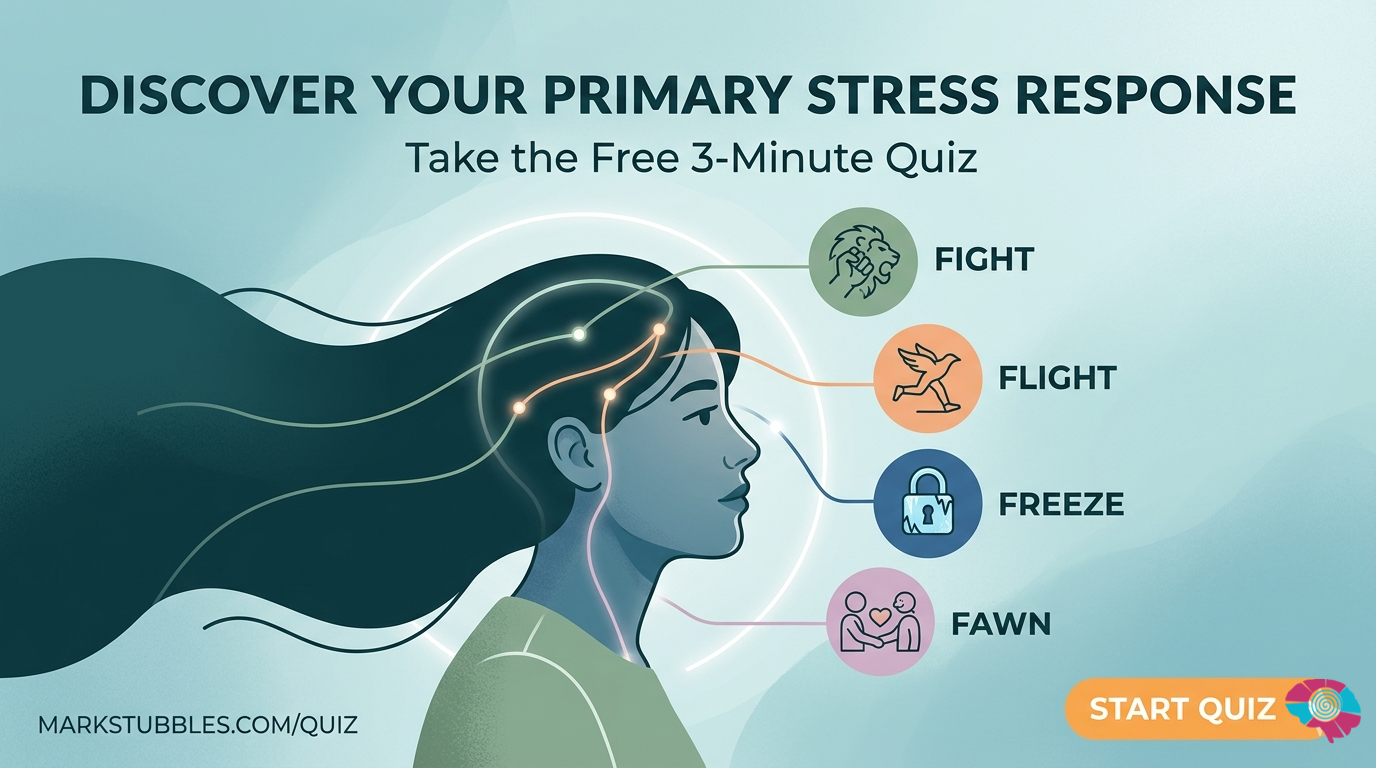
During relationship push-pull dynamics, your nervous system relies on four primary stress responses to manage perceived danger:
- Fight Response: Expresses as anger, criticism, demanding behaviour, or picking arguments to force the other person to respond and prove they care.
- Flight Response: Expresses as sudden emotional withdrawal, physically leaving, ghosting, or hyper-focusing on work to escape vulnerable feelings.
- Freeze Response: Expresses as emotional numbness, brain fog, feeling paralysed during conflict, or going completely blank when asked about your feelings.
- Fawn Response: Expresses as chronic people-pleasing, over-functioning, abandoning your own boundaries, and adopting an approval addiction to keep the peace.
When Fawn is your primary survival mechanism, you develop a deep approval addiction. You sacrifice your own emotional needs, swallow your true feelings, and monitor your partner’s mood with hyper-vigilant intensity. You become a shape-shifter, adapting yourself entirely to keep the other person calm and prevent them from leaving.
Constantly cycling through these four survival responses creates severe nervous system burnout. Long-running stress is linked with fatigue, disrupted sleep, digestive problems, and anxiety, leaving the brain stuck in constant threat monitoring. Learning how focused attention state neurological mechanisms operate helps explain why the brain becomes locked in chronic hyper-vigilance.
Self-Sabotage and the Upper Limit Problem
A frequent and painful aspect of relationship push-pull dynamics is self-sabotage. Many people find that just when a relationship becomes peaceful, supportive, and stable, they suddenly feel an urge to ruin it or walk away. They ask themselves: Why do I sabotage good things when they are going well?
In psychology, this phenomenon is known as the Upper Limit Problem. Every person has an unconscious emotional thermostat that dictates how much peace, love, and success they can tolerate before feeling uncomfortable. If your baseline template was forged in chaotic or unpredictable environments, your upper limit for calm intimacy is set quite low.
When a healthy relationship exceeds your unconscious upper limit of safety, your internal alarm system treats the quiet peace as suspicious. Your brain thinks: This is too quiet, something bad is about to happen. To relieve the unbearable tension of waiting for the other shoe to drop, your unconscious mind creates a crisis. It causes you to sabotage the connection, returning your nervous system to its familiar state of stress and vigilance.
The Shadow Child and Family Conditioning
Self-sabotage is heavily driven by what therapists refer to as the Shadow Child, the hidden, wounded parts of your younger self that adopted protective survival strategies. If you grew up in a home where expressing needs led to rejection or punishment, your Shadow Child learned that being truly vulnerable is dangerous.
Furthermore, approval addiction and people-pleasing are often multi-generational patterns. If you watched your parents sacrifice their self-respect or tolerate emotional coldness to keep a family together, your unconscious mind inherited that relational template. Breaking free requires recognising that these habits were once necessary survival adaptations, but they are now keeping you trapped in adult suffering.
Why Talk Therapy and Logic Fall Short
Many people spend years in traditional talk therapy analysing their romantic patterns. They can explain their attachment styles in clear detail, cite their childhood wounds, and list every red flag in their current partner. Yet, despite this vast intellectual knowledge, when they meet someone new, the exact same magnetic pull toward unpredictable people happens anyway.
Why does intellectual insight fail to change relationship choices?
Intellectual understanding lives in your conscious prefrontal cortex, which governs approximately 5 percent of total brain function. Meanwhile, the automated drive to seek familiar emotional patterns, trigger the fight-or-flight response, and execute the push-pull loop is stored in the subcortical brain and autonomic nervous system, governing the remaining 95 percent.
You cannot talk your way out of an automatic survival reflex. Attempting to manage relationship push-pull dynamics through sheer conscious willpower is exhausting and ineffective because it leaves the underlying neural map completely untouched. Real, lasting freedom requires updating the initial template so that emotional chaos completely loses its magnetic pull.
| Feature | Conscious Logic & Talk Therapy | Unconscious Reconditioning |
| Target Brain Level | Thinking Prefrontal Mind (Conscious logic, 5%) | Autonomic Nervous System & Unconscious (95%) |
| Primary Method | Analysing past events, talking, using willpower | Hypnotic state, memory reconsolidation in theta |
| Immediate Effect | Intellectual understanding of relationship triggers | Physiological calm & neutralized emotional charge |
| Long-Term Outcome | Requires constant conscious effort to manage choices | Destroys the magnetic attraction to chaos at the root |
When considering therapeutic pathways, reviewing 1-to-1 hypnotherapy vs audio recordings helps clarify how personalised, individual sessions neutralize deep-seated emotional reactions far better than generic tracks. Furthermore, examining DMN ego dissolution compared across altered states shows how quietening the brain’s internal narrative creates space for lasting behavioural transformation.
Reconditioning Your Template | From Familiar Chaos to Healthy Love
How do we update an unconscious survival map so that emotional consistency feels attractive and safe?
Neuroscience has established that long-term emotional memories and relational templates are not permanent fixtures. Through a natural process called memory reconsolidation, the brain can update old emotional associations permanently.
During hypnotherapy, your brain enters a deeply relaxed theta state (4 to 8 Hz). In theta, analytical prefrontal guardrails soften, granting access to the subcortical networks where early relational maps are stored. While holding the old emotional memory active, we introduce a profound experience of present-tense physiological safety. This creates a neural mismatch, opening the memory file and allowing your brain to rewrite the old association.
Resetting the Reticular Activating System for Healthy Connection
As your unconscious map updates, your Reticular Activating System undergoes an immediate reset. It stops flagging emotional distance as exciting chemistry and stops viewing consistent availability as boring. Healthy, peaceful partners suddenly appear attractive, stable, and desirable.
Integrating John Bradshaw Inner Child Methods
To complete this transformation, we integrate proven clinical inner child methods pioneered by John Bradshaw. Through guided letter writing, dialoguing between your adult self and wounded inner child, and releasing toxic shame, you address the root feelings of unworthiness that drive approval addiction. When your inner child feels genuinely safe and protected by your adult self, the desperate need to seek external validation from emotionally unavailable partners dissolves.
Establishing Authentic Boundaries Without Guilt
Another vital aspect of reconditioning is learning to set authentic boundaries without guilt. For many people raised in chaotic environments, guilt is a learned trauma response, a false signal that having independent needs is selfish or dangerous. By aligning your boundaries with your authentic values, you protect your emotional peace without needing to push people away or fawn for approval.
For a detailed exploration of how early conditioning shapes adult choices, explore my Unlearn Your Fear book or learn more about specialised inner child healing hypnosis. If you prefer a structured self-paced pathway, my 4-week anxiety hypnosis course provides practical daily exercises. You can also join my live online Inner Child Pop-up Workshop for interactive guidance.
Four Practical Steps to Interrupt the Push-Pull Cycle
While unconscious reconditioning resolves the underlying threat map, you can implement this 4-step practical protocol whenever you notice the urge to push or pull in your current relationship:
Step 1 – Identify the Survival Response: The moment you feel an overwhelming urge to text obsessively (Pull) or pick a fight to create distance (Push), pause and label the state: “My nervous system is experiencing a survival response right now.”
Step 2 – Calm the Physical Alarm: Engage your vagus nerve by taking two quick inhales through your nose followed by a long, extended sigh through your mouth. Soften your visual focus to include your far peripheral surroundings, signaling safety to your brainstem.
Step 3 – Question Your Internal Filter: Ask yourself calmly: “Is this person actually dangerous, or is this connection simply unfamiliar and quiet?” Distinguish between real red flags and nervous system discomfort.
Step 4 – Choose an Authentic Action: If you feel the urge to chase, step back and engage in an external task. If you feel the urge to run away, express a simple, honest boundary instead of manufacturing conflict.
In cases where unresolved nervous system tension manifests in other automatic physical habits, such as night-time jaw clenching, exploring thegosis biological jaw tension reflex demonstrates how emotional pressure releases across physical pathways.
Frequently Asked Questions About Relationship Push-Pull Dynamics
What causes relationship push-pull dynamics?
Relationship push-pull dynamics are caused by an unconscious survival template that equates emotional instability with connection and love. When early life involved inconsistency or unpredictable attention, your nervous system seeks out familiar emotional roller coasters, confusing anxiety with romantic chemistry.
Why does healthy stability feel boring after toxic relationships?
Healthy stability feels boring because your Reticular Activating System is accustomed to high levels of stress hormones like adrenaline and cortisol. Without the anxiety of unpredictable dynamics, a quiet and consistent connection is filtered out as unexciting until your baseline template is reconditioned.
Can hypnotherapy stop you from chasing unavailable partners?
Yes, hypnotherapy helps stop the habit of chasing unavailable partners by accessing the subcortical mind in a relaxed theta state. This allows you to update early emotional maps, neutralizing the drive to seek validation through difficult relationship dynamics.
Why does logical thinking fail to break relationship patterns?
Logical thinking fails because conscious analysis controls only about 5 percent of total brain processing. Relationship choices, attraction responses, and survival panic are driven by the 95 percent managed by your autonomic nervous system and unconscious templates.
Neutralize the Pattern at its Source
You do not have to spend the rest of your life repeating the same exhausting relational loops. Your desire for love, closeness, and security is completely healthy, and your nervous system is fully capable of learning to feel safe in peaceful connection.
By updating your underlying emotional template, you turn off the false alarm, quiet the drive for familiar chaos, and open your life to healthy, enduring love.
| Ready to Break Free From Relationship Push-Pull Dynamics? If you are exhausted by repeating the same emotional cycles, I invite you to take the next step. In a confidential consultation, we will map out your specific relationship triggers and create a personalized hypnotherapy plan to update your emotional baseline. Book a free consultation call today to begin neutralizing the pattern at its source. |





Leave a Reply