Online Hypnotherapy for Anxiety Relief & Stress Management
Break the Cycle of Chronic Worry, Panic Attacks, and Nervous System Overload
Anxiety was an overwhelming barrier in my own life. It actively stopped me from making friends, forming healthy relationships, and enjoying my everyday experiences. It caused me to suffer all kinds of personal and professional difficulties. Until I used hypnotherapy to overcome it, chronic panic was a constant, exhausting background noise. A deep fear of blushing, known as erythrophobia, was my primary trigger, leaving me constantly worried about how other people perceived me. This experience inspired me to write my guide, Beyond Blushing, I used hypnotherapy to stop blushing and to help others break free from this exhausting panic loop.
My Anxiety Clients Get Results
“My anxiety was so bad I could not sleep for over 2 weeks. I contacted Mark who is a brilliant hypnotherapist. He was very kind, flexible and supportive in helping me overcome my anxiety issues.
He is genuinely committed to seeing his clients succeed. My sleep has improved and my anxiety has reduced with the hypnosis sessions and techniques Mark has taught me.”
Schedule Your Free Call Below To Find Out More
Shifting from Avoidance to Action: Resolving Social Anxiety
In social settings, my palms would sweat and my face would turn bright beetroot red. The harder I tried to suppress these automatic physical reactions, the worse they became. As I always emphasize to my clients and workshop attendees, what you resist not only persists but becomes stronger. This persistent social anxiety stopped me from forming lasting friendships and made it incredibly difficult to keep jobs. I went through countless positions after being thrown out of college.
The only roles I could hold down were in sales, because the focus was entirely on targets and results rather than how I was behaving. Being on a sales call gave me a vital external focus. When I was thinking about a customer’s needs, I was not locked inside my own head worrying about what people thought of me or whether my cheeks would burn. In retrospect, this sales environment acted as a subconscious distraction from my social panic.
But even in sales, anxiety severely reduced my career prospects. It led to what one manager kindly referred to as idiosyncrasies, which were unusual physical behaviors I had developed to try to soothe my overactive system. These habits stopped me from being taken seriously or being promoted. My reduced social circle and the difficulty maintaining authentic connections eventually contributed to getting married far too young, followed by a turbulent and painful divorce.
My childhood environment taught my subconscious that being seen as an independent person was highly dangerous, and that safety lay in remaining completely invisible. But because these patterns were learned, they can be unlearned. Today, my passion is helping people break free from these same survival loops, helping them move from a state of passive avoidance to calm, grounded action.
Why Thought Fails to Stop Chronic Anxiety
Anxiety is a word we hear constantly, with recent statistics indicating that around twenty-five percent of the population in the United Kingdom experiences anxiety or depression, and roughly nine percent grapple with both simultaneously. But here is a crucial point: anxiety itself is not a disease, a permanent mental illness, or an inherent brain defect. Instead, your physical anxiety symptoms are your body’s innate alarm system, a natural, evolutionary response designed to protect you from immediate physical danger in the wild.
If you were being chased by a grizzly bear, you would find this intense physical response incredibly beneficial. The racing heart, the heightened senses, the sweating palms, and the tunnel vision are all coordinated by the sympathetic branch of your autonomic nervous system. Hormones like cortisol and adrenaline flood your bloodstream, preparing your muscles for battle. The sudden sweat is designed to regulate your body temperature during physical exertion, and your tunnel vision sharpens your focus to track the threat.
This is a subcortical, lightning-fast survival mechanism operating exactly as designed. It is not about eliminating these physical feelings entirely, because that is simply not how the human body is wired. However, when this natural defense is triggered inappropriately or becomes a chronic state, the very mechanisms designed to protect you become highly debilitating. That same visual tunnel vision now impairs your working memory, clouds your concentration, and blocks clear, logical decision-making.
This explains the profound Logic Gap in anxiety recovery: you cannot use conscious logic to negotiate with an involuntary physical reflex. Your conscious, logical mind only operates about five to ten percent of your total behavior, running on language and reasoning. The remaining ninety to ninety-five percent is managed entirely at an unconscious level by your autonomic nervous system. When a physical trigger fires, it bypasses your conscious prefrontal cortex completely. You cannot talk yourself out of a panic loop, because your rational mind is attempting to reason with an automatic reflex that does not speak in language.
Understanding and Resetting Panic Attacks
A panic attack is a sudden, overwhelming surge of intense fear that peaks within minutes, triggering a profound physical response. While generalized anxiety is a chronic, background state of worry, a panic attack is an acute autonomic hijack. Your sympathetic nervous system fires a massive emergency signal, flooding your body with adrenaline. Your heart rate spikes, your breathing becomes rapid and shallow, and you may experience chest tightness, dizziness, or a feeling of impending doom. This is your evolutionary survival mechanism operating at maximum capacity, mistakenly treating a psychological trigger as an immediate physical threat. To interrupt an acute panic attack in the moment, you must bypass conscious logic and communicate directly with your nervous system through physical, body-based resets. A highly effective method is the physiological sigh (taking two quick, deep breaths in through your nose, followed by a long, slow exhale through your mouth). This physical action rapidly triggers the vagus nerve, signaling the parasympathetic nervous system to slow your heart rate and restore autonomic balance. In my work, we work at an unconscious level to recondition the underlying threat responses, ensuring your system no longer triggers these acute panic loops in everyday situations.
To understand how a subtle environmental trigger can rapidly spiral through your autonomic nervous system into full-blown panic or freeze, explore my complete pillar guide on how anxiety escalates, which details the six chronological stages of nervous system hijacking.
The Neuroscience of Hypervigilance & Fight-or-Flight
Here is a fascinating neurobiological insight: humans are born with only two fundamental fears, the fear of falling and the fear of loud noises. Every other fear, phobia, and anxious pattern is learned as we grow. Until around the age of seven, a child’s brain operates predominantly in a theta brainwave state, a highly receptive frequency known as the imprint period. During this time, neuroplasticity is at its absolute peak.
In prehistoric times, rapidly absorbing what was safe and what was dangerous from our tribe was crucial for our survival. This tendency to learn through observation persists today. Children look to their primary caregivers for feedback on their environment, and if they witness a parent in a state of constant anxiety, they adopt the unconscious belief that the world is an inherently dangerous place.
Growing up around family dysfunction, persistent criticism, or emotional invalidation is one of the most common causes of adult panic. To protect ourselves, our unconscious mind builds a survival map based on those early experiences. The child who had to constantly monitor a parent’s face for the first sign of anger grows into an adult whose attention filter, the Reticular Activating System (RAS) in the brainstem, is permanently locked in threat-detection mode. This early childhood conditioning does not come with an expiration date (a topic I explore further in my upcoming comprehensive guide to chronic hypervigilance); what we do not heal, we tend to carry forward, unconsciously inviting the same anxious struggles into our adult lives.
Common Signs Your Nervous System is Stuck in Threat Mode
When your nervous system is stuck in persistent sympathetic activation, it produces widespread, chronic physical symptoms that go far beyond simple worry. Because your autonomic survival response is continuously active, your body is forced to divert critical energy away from long-term maintenance functions to focus on immediate survival. This constant drainage manifests in several recognizable physical signs:
- Immune System Suppression: In the face of immediate danger, your immune system takes a backseat. Energy is diverted away from fighting off viruses and bacteria, leaving you far more vulnerable to frequent colds, infections, and chronic physical fatigue over the long term.
- Digestive System Disruption: Digestion requires enormous metabolic energy, which your autonomic nervous system believes is better used for fighting or fleeing. This leads to a suppressed appetite, feelings of nausea, or even vomiting under stress. People prone to chronic worry are also significantly more susceptible to irritable bowel syndrome (IBS), highlighting the powerful gut-brain connection.
- Chronic Muscular Tension: Because your system is in a state of braced readiness, scanning for danger, you hold massive amounts of physical tension in your body. This tension accumulates heavily in the neck, jaw, and shoulders, frequently resulting in tension headaches, muscle stiffness, and chronic sleep bruxism (nighttime teeth grinding).
These physical symptoms are the natural consequences of a nervous system that has not learned to fully release its vigilance. Over time, this chronic tension drains your vital energy, leading to a profound sense of exhaustion and physical depletion. To find lasting relief, we must look past superficial symptom management. A landmark 2019 clinical meta-analysis on hypnosis for anxiety published on PubMed by Dr. Vance Milling and colleagues found that, on average, people treated with hypnosis showed greater clinical improvement than approximately eighty-four percent of control participants, proving that working with these patterns at an unconscious level is highly effective for resetting the overactive threat alarm.
Why Hypnotherapy Bypasses Rational Logic to Resolve Anxiety
When I work with a client on anxiety, my first question is always to understand when the pattern began and what was occurring in their life at that time. If there was a specific traumatic incident, such as a public humiliation, a sudden loss, or a difficult relationship breakdown, we work to remove the negative emotional charge from that memory. You can explore my specialized approach to healing the root of trauma and C-PTSD to see how this works. Traumatic memories carry far more emotional weight because the brain attaches survival significance to them. In prehistoric times, this was highly useful to keep us safe from repeating dangerous mistakes. In modern life, it keeps us trapped in patterns of fear and avoidance long after the original danger has passed. This helps release the automatic threat responses stored in your subconscious memory.
Importantly, we can neutralize the emotional charge in a traumatic memory without requiring you to fully relive the distress. If a client grew up in a dysfunctional environment, we typically combine our anxiety work with inner child healing hypnosis. The purpose of this work is to help the inner child feel safe, loved, and accepted.
But even if a client cannot or does not want to address a specific memory, hypnosis is still highly effective. This is because the subconscious mind cannot distinguish between a vividly imagined event and a real one. Visualizing yourself feeling calm, relaxed, and confident in situations that previously triggered panic builds new neural pathways in the brain. With repetition those pathways strengthen and the calm response begins to feel completely natural, letting you comfortably step out of your comfort zone.
| VIDEO: Watch “3 Practical NLP Techniques for Instant Calm” on YouTube In this live session recording, I break down exactly how anxiety functions as a conditioned response and guide you through three powerful tools from Neuro-Linguistic Programming (NLP) that you can use to interrupt anxious patterns in real time: • The Anxiety Anchor: How to use physical conditioning to trigger a rapid state of calm and confidence whenever you need it. • The Dimmer Switch: A simple exercise to turn down the volume on negative internal thoughts and critical voices. • The Swish Pattern: A rapid mental exercise designed to replace old anxiety triggers with a calm, resourceful version of yourself. |
What Happens During an Online Hypnotherapy Session for Anxiety?
Many people still assume they need to see a hypnotherapist in person to get results. In reality, online sessions via Zoom or Google Meet work just as well as face-to-face therapy, and are often more effective for people dealing with intense panic or social anxiety. The biggest reason is comfort. Doing the session from your own home means you are already in the environment where you feel most at ease. There is no stressful journey to make, no unfamiliar waiting room to sit in, and no busy commute to deal with, which is especially helpful for clients experiencing driving anxiety and highway panic, or those seeking hypnotherapy for agoraphobia who find leaving the home highly stressful.
Unlike the stage hypnosis seen in the media, professional hypnotherapy is a highly cooperative, respectful process. You remain in complete control throughout the entire session. You cannot be made to do or say anything that conflicts with your core values, safety, or personal beliefs. Think of it as a deeply relaxed state of focused attention, where we work collaboratively to quiet the analytical mind and access the unconscious space where your automatic habits reside.
My online sessions are longer than the standard hour, running between ninety and one hundred and twenty minutes. We spend the first forty to sixty minutes getting to understand your situation, using conversational techniques and NLP to help you start seeing things differently before the formal hypnosis begins. I do not use standardized scripts; I tailor every session to the specific needs of each client. I also suggest physical exercises and supportive homework between sessions to help you build on what we cover together. Most clients report feeling a positive, durable shift within their first three sessions, finding a significant, lasting reduction in their anxiety levels.
Your Online Hypnotherapy Journey: Step-by-Step
- The Safe Space Consultation: We begin by mapping your current anxiety triggers and outlining your personal goals. This is a secure, confidential space where you do not need to verbally disclose any painful details of your past history.
- The Perspective Shift: Using conversational NLP and gentle cognitive reframing, we help your mind start viewing old triggers through a lens of safety, calming the analytical conscious mind before the hypnosis begins.
- The Unconscious Update: Entering a deeply relaxed state of focused attention, we work collaboratively to access the subcortical space where your automatic threat responses are stored, updating your safety map.
- The Daily Integration: After the session, you receive physical exercises and supportive homework to implement in your home environment, reinforcing your new, calm pathways in your everyday life.
Investment, Scheduling, and Global Access
Investing in 1-on-1 online hypnotherapy is a direct, focused commitment to your long-term emotional freedom. Unlike open-ended, months-long talk therapies, my work is structured to achieve rapid, durable shifts. We will discuss tailored program options and investment levels transparently during your free call. To make my work accessible worldwide, I support clients across the UK, US, and international timezones, offering flexible scheduling to accommodate different regions safely online. Many clients find that conducting sessions in their own comfortable space eliminates the stress of travel and speeds their recovery.
Hypnotherapy for Stress Relief: A Modern Solution
While stress and anxiety can feel overwhelming, they are essentially the body’s “Fight or Flight” response stuck in the “on” position. As a Hypnotherapist, I specialize in helping you switch that response off. Through Online Hypnotherapy (via Zoom or Google Meet), we can bypass the conscious “chatter” of the mind and work directly with the unconscious. This process allows us to:
- Rapidly reduce physical symptoms like increased heart rate and that “knot” in the stomach.
- Reprogram the brain for long-term resilience, helping you develop healthier ways to perceive and cope with daily pressures.
- Find immediate relief in a safe, relaxing environment from the comfort of your own home.
Unlike traditional talk therapies that can take months to show results, hypnotic language and trance work often provide a quicker, more sustainable shift in how you feel and react.
Ready to reclaim your calm? I offer a Free Hypnotherapy Consultation to discuss your specific situation and show you how we can work together to lower your stress levels. Simply select a good time for you above or visit the free consultation page.
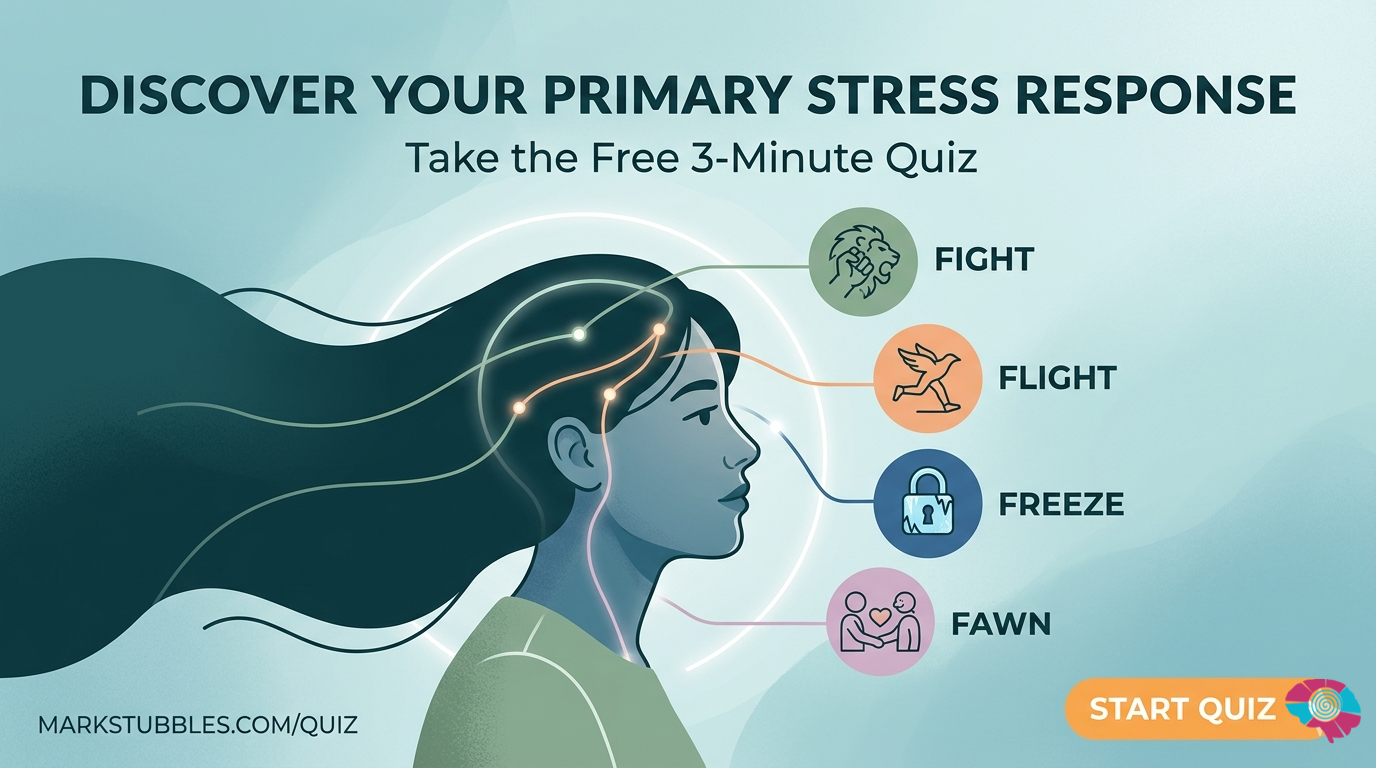
If you are not quite ready to talk, you can take my free stress-response quiz to discover how your nervous system currently copes with pressure and identify your primary triggers.
Further reading:
Definitive guide to overcoming anxiety
Why traditional sleep hygiene fails
Comparing Anxiety Recovery Approaches
While traditional methods focus heavily on managing symptoms or challenging conscious thoughts, hypnotherapy is the only approach that works directly with the subcortical reflexes of the autonomic nervous system to achieve a permanent, unconscious-level shift in your threat response. The table below outlines how these common approaches compare:
| Approach | Target Level | Primary Mechanism | Sustainability & Outcomes |
| Hypnotherapy | Unconscious autonomic nervous system and subcortical reflexes. | Guided trance and memory reframing to update safety maps. | Direct and rapid; changes the root response so relief persists after sessions end. |
| CBT (Cognitive Behavioral Therapy) | Conscious prefrontal cortex (rational thought and behavior). | Logical analysis, thought challenging, and coping exercises. | Useful for surface management, but requires constant conscious effort when a reflex triggers. |
| Medication (e.g., SSRIs) | Neurochemical environment (physiological signal regulation). | Pharmacological reduction of physical symptom intensity. | Temporary symptom management; the underlying threat response remains active when medication ends. |
| Mindfulness & Meditation | Conscious autonomic regulation (in-the-moment calming). | Focused breathing and attention control to soothe active stress. | Excellent for daily maintenance, but difficult to maintain during acute panic attacks. |
Frequently Asked Questions: Hypnotherapy for Anxiety
The journey from chronic panic to lasting emotional freedom requires more than just understanding your past; it requires a physiological shift in how your nervous system responds to old imprints. These FAQs outline how hypnotherapy addresses these automatic patterns at an unconscious level.
Is hypnotherapy a viable alternative to medication for anxiety?
For many people, yes. Hypnotherapy addresses the subconscious conditioning that drives chronic anxiety, the thing medication cannot touch.
Antidepressants and anxiolytics can reduce the intensity of symptoms, but they don’t update the learned threat responses running beneath conscious awareness. When the prescription ends, the pattern is still there.
Hypnotherapy works at the level where the pattern was installed, which is why results tend to persist after treatment ends. If you’ve been offered medication and want to explore a non-pharmaceutical route first, a free consultation call is a good place to start.
What If I've Already Tried Therapy and It Didn't Work?
This is one of the most common things I hear, and it makes sense. CBT and talk therapy are genuinely useful for many people. They help you identify distorted thinking patterns, challenge unhelpful beliefs, and build better coping strategies. If you’ve done that work and still feel anxious, it doesn’t mean therapy failed you. It means you were working at the level of conscious thought, and your anxiety isn’t living there.
Chronic anxiety is a subconscious process. It runs below the level of rational analysis, which is precisely why you can understand intellectually that a situation isn’t dangerous and still feel your chest tighten and your thoughts spiral the moment you’re in it. Knowing why you’re anxious rarely stops you being anxious. The conditioned threat response that drives your symptoms was installed before you had the cognitive tools to examine it, and it doesn’t respond to examination now.
Hypnotherapy works at the level where the pattern actually is. In the focused relaxation of the hypnotic state, we can access the subconscious associations that are triggering the response and update them directly, rather than reasoning with the surface expression of them. For many people who felt stuck after talk therapy, this is the missing piece.
Can I Have Hypnotherapy If I'm Taking Medication for Anxiety?
Yes. Hypnotherapy is completely compatible with SSRIs, beta-blockers, and other medications commonly prescribed for anxiety. There are no contraindications. You do not need to reduce or stop your medication before starting sessions, and I would never suggest you do so without guidance from your prescribing doctor.
What medication and hypnotherapy are doing is different enough that they work well alongside each other. Medication regulates the neurochemical environment, reducing the intensity of anxiety symptoms at a physiological level. Hypnotherapy works on the learned threat responses and subconscious associations that are generating those symptoms in the first place. One manages the signal; the other addresses what’s sending it.
Many of my clients come to hypnotherapy while on medication, often because they want to treat the root cause rather than manage symptoms indefinitely. Some find that as the underlying patterns shift through our work together, they are in a better position to have a conversation with their doctor about their medication over time. That is always a decision made with medical supervision, not something I direct or advise on, but it reflects the kind of durable change that hypnotherapy makes possible.
How does hypnotherapy work for chronic anxiety?
Hypnotherapy accesses the unconscious mind where automatic stress responses and threat detection patterns reside. By quieting active conscious overthinking, hypnosis helps recondition your nervous system to regulate properly, lowering cortisol and adrenaline so you stay calm in everyday situations.
Why can't I just think my way out of anxiety?
Anxiety is generated by the autonomic nervous system before conscious reasoning takes effect. Telling yourself to calm down operates in the conscious mind, whereas the threat alarm is fired automatically at an unconscious level. Hypnotherapy works directly at the level where the alarm originates, allowing the nervous system to update its map and establish true physical safety.
How many online hypnotherapy sessions are needed for anxiety?
Many clients notice an immediate reduction in physical tension and anticipatory dread within one to three sessions. Because hypnotherapy addresses root patterns rather than surface symptoms, changes happen faster than with traditional talk therapy. We assess your progress after each session, ensuring you stay in complete control of your healing pace.
Is online hypnotherapy for anxiety as effective as in-person therapy?
Yes. Online sessions via video call are fully as effective as in-person sessions. Experiencing hypnotherapy in the comfort and safety of your own home environment often makes it easier to relax deeply and integrate new unconscious patterns, with clinical studies showing comparable, durable results.